 Nurturing Marriages, Enriching Families!
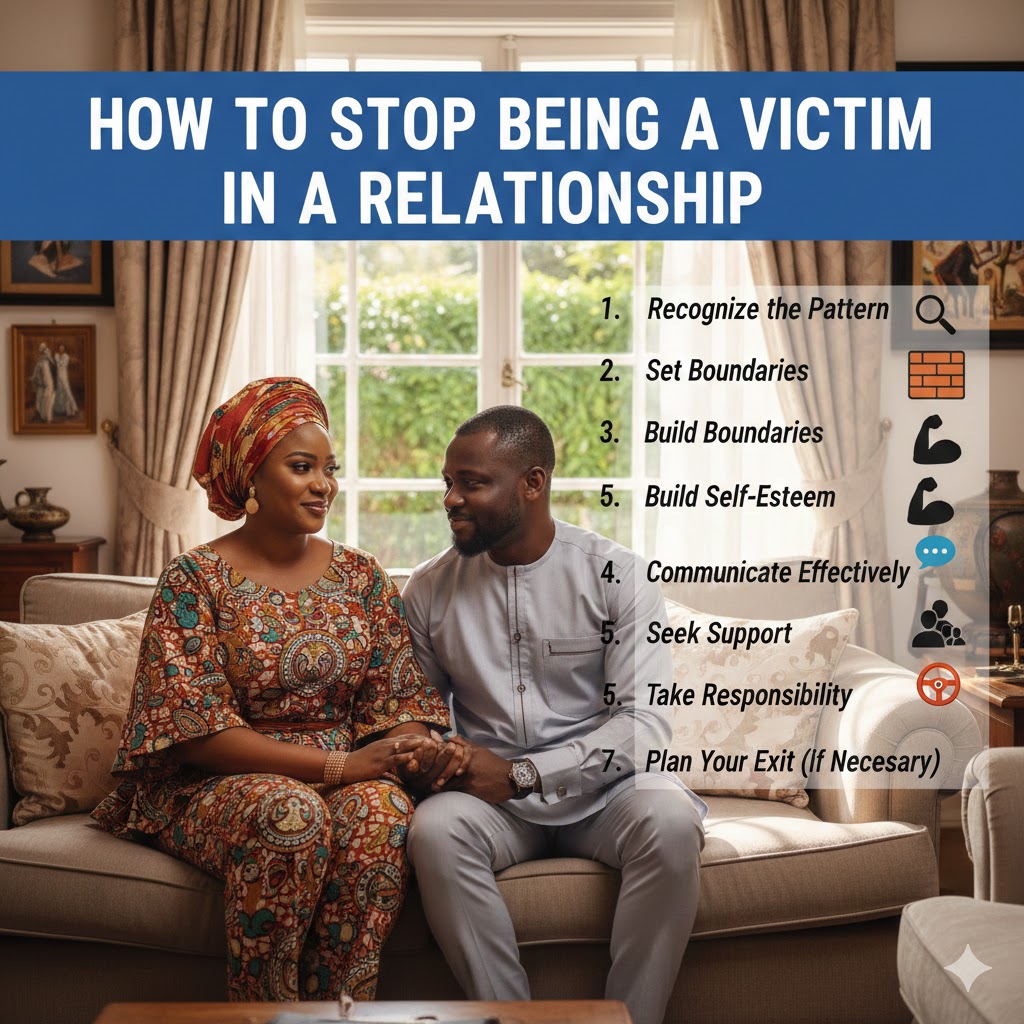
How to Stop Being a Victim in a Relationship: Seven (7) Tips
Feeling like a victim in a relationship can slowly drain your confidence, emotional strength, and sense of self-worth. It often shows up as constantly feeling unheard, powerless, blamed, manipulated, or emotionally controlled. Over time, you may begin to doubt yourself, suppress your needs, or accept unhealthy behavior just to keep the peace.
In Nigerian relationships, this pattern is sometimes reinforced by cultural expectations, family pressure, fear of stigma, or the belief that endurance equals love. However, love should never require self-erasure. Moving from a victim mindset to a position of emotional strength is not about becoming aggressive or selfish—it is about reclaiming your voice, boundaries, and dignity.
Here are seven practical tips to help you stop being a victim in a relationship and begin living from a place of confidence and emotional independence.
1. Acknowledge the Pattern Honestly
The first step to change is honesty with yourself. Many people remain stuck in victimhood because they minimize or excuse unhealthy dynamics. You may tell yourself that things will improve, that your partner is just stressed, or that enduring pain is part of commitment.
Acknowledging that you feel emotionally trapped, silenced, or disrespected is not weakness—it is clarity. When you name the pattern, you take the first step toward breaking it. Denial keeps you powerless; awareness gives you options.
Ask yourself: Do I feel safe expressing my feelings? Do I often blame myself for issues I didn’t cause? Do I feel smaller in this relationship than I used to?
2. Stop Over-Explaining and Seeking Approval
One common sign of victimhood is the constant need to explain yourself, justify your feelings, or seek permission to exist comfortably in the relationship. You may feel compelled to prove that your pain is valid or that your needs are reasonable.
Healthy partners do not require endless explanations to show empathy. When you stop over-explaining, you send a powerful message: my feelings matter, even if they are uncomfortable to hear.
Practice stating your needs calmly and clearly, without begging for understanding. You are not wrong for having boundaries or emotions.
3. Take Responsibility for What You Can Control
Being a victim often feels like everything is happening to you. While you may not control your partner’s behavior, you do control your responses, boundaries, and decisions.
This shift is powerful. It moves you from helplessness to agency. Instead of focusing on changing your partner, ask: What choice do I have right now? What action protects my emotional well-being?
In Nigerian contexts, this may involve difficult decisions—speaking up despite family pressure, refusing emotional manipulation, or choosing counseling instead of silence. Responsibility does not mean blame; it means ownership of your life.
4. Set and Enforce Clear Boundaries
Victimhood thrives where boundaries are weak or absent. If your partner repeatedly disrespects your limits and there are no consequences, the behavior will continue.
Boundaries are not threats or ultimatums. They are clear statements of what you will and will not accept—and what action you will take if those boundaries are crossed.
For example, saying “I will not continue conversations where I am insulted” and actually disengaging when insults begin is boundary enforcement. It teaches others how to treat you and restores self-respect.
5. Rebuild Your Self-Worth Outside the Relationship
Many people feel trapped in victimhood because their identity and self-worth are tied solely to the relationship. When your value comes only from being chosen, loved, or approved by your partner, you become emotionally dependent.
Reclaiming your self-worth means reconnecting with who you are outside the relationship—your skills, passions, faith, friendships, and goals. When you remember your value, you stop tolerating emotional neglect or manipulation.
In Nigeria, this may involve reconnecting with trusted friends, mentors, faith communities, or personal ambitions that were put aside to “keep the relationship.”
6. Stop Normalizing Emotional Pain
One of the most dangerous traps in relationships is normalizing pain. Statements like “marriage is hard,” “that’s how men are,” or “all relationships have issues” are often used to justify emotional harm.
Yes, relationships require effort—but they should not consistently make you feel worthless, fearful, or emotionally unsafe. Love does not thrive where respect is absent.
When you stop normalizing pain, you begin to recognize that peace, safety, and mutual respect are not luxuries—they are necessities.
7. Be Willing to Choose Yourself
Stopping victimhood sometimes requires a hard truth: not all relationships can be saved at the cost of your mental health. Choosing yourself may mean demanding change, seeking professional help, emotionally detaching, or even walking away if nothing improves.
This is especially difficult in Nigerian society, where staying is often praised more than healing. But choosing yourself is not selfish—it is survival. A healthy relationship should add to your life, not consume or diminish it.
Choosing yourself means believing that you deserve love that is safe, respectful, and emotionally nourishing.
Being a victim in a relationship is not a permanent identity—it is a position you can move out of with awareness, courage, and action. The moment you begin to honor your voice, set boundaries, and take responsibility for your emotional well-being, the power dynamic shifts.
You are not too sensitive. You are not asking for too much. You are asking for basic emotional respect.
Healthy love does not silence you. It strengthens you.







.jpg)

Sign in to comment