 Nurturing Marriages, Enriching Families!
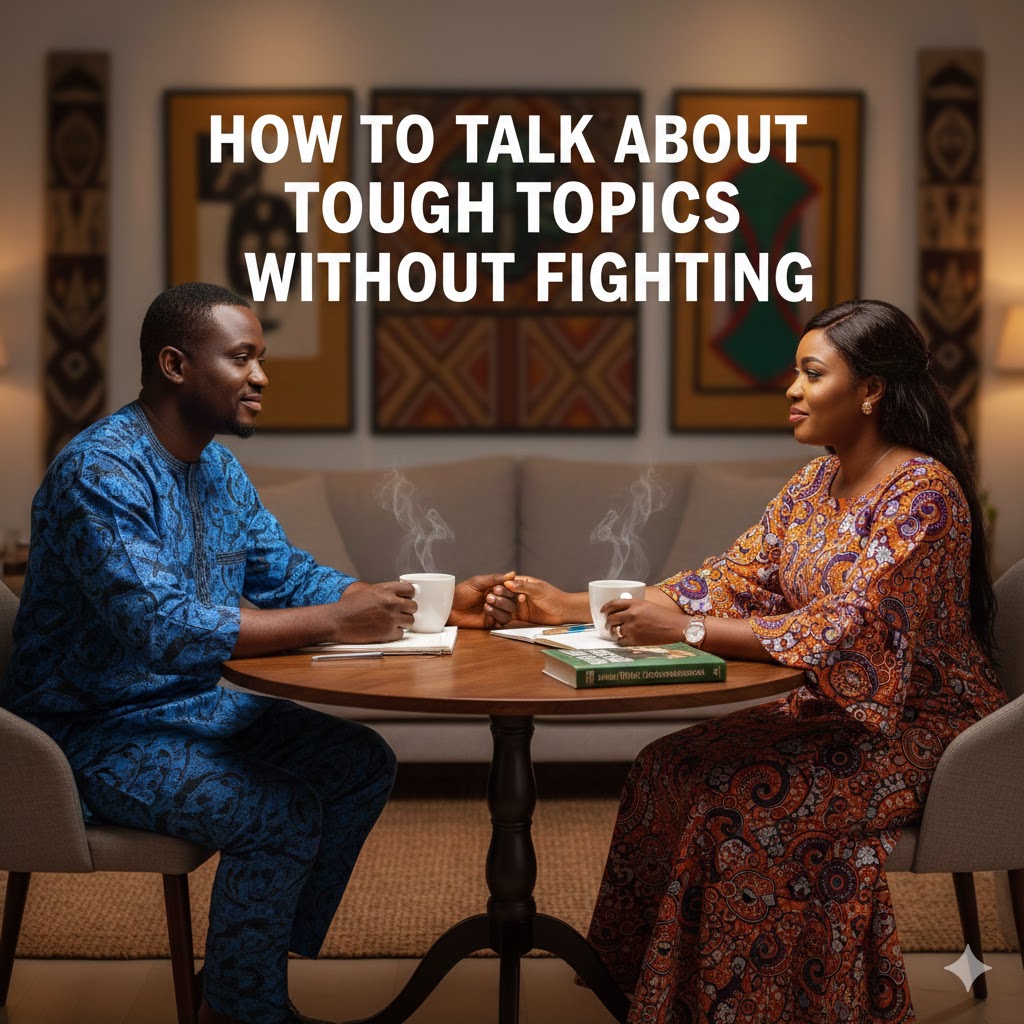
How to Talk About Tough Topics Without Fighting
Every marriage and long-term relationship faces tough conversations. Money, family, intimacy, career choices, and future plans are often at the heart of disagreements. How couples handle these conversations can either strengthen the relationship or create lasting conflict. Many Nigerian couples struggle with these discussions because cultural expectations, extended family involvement, and gender norms can intensify emotions. The key is learning to talk about tough topics without turning every conversation into a fight.
Talking about difficult subjects requires more than restraint—it demands intentionality, emotional awareness, and skill. Couples who navigate challenging discussions effectively do not avoid conflict; they transform it into opportunities for connection, understanding, and growth.
Understanding the Root of Tough Conversations
Tough conversations usually touch on vulnerability, differences in opinion, or areas where partners feel threatened. In Nigerian marriages, financial disagreements, in-law involvement, religious practices, and career ambitions are common triggers. For example, consider a couple, Chioma and Emeka, living in Lagos. Chioma wants to invest in a small business, but Emeka feels they should save more before risking capital. Their disagreement is not about love or commitment but about values, priorities, and risk tolerance. If handled poorly, such discussions can escalate into shouting matches or silent resentment.
Recognizing the underlying issue is the first step in talking without fighting. Is the conflict about resources, respect, fear, or unmet expectations? When partners can identify the core of their emotions, discussions become more solution-focused and less personal.
Emotional Preparedness
Before initiating a tough conversation, emotional preparedness is essential. Speaking while frustrated, angry, or exhausted almost always leads to escalation. Couples should take time to calm down, process emotions, and clarify what they want to communicate.
In Nigeria, cultural expectations sometimes discourage open emotional expression, particularly for men. A husband may bottle up frustration about family interference, while a wife may avoid raising concerns about finances to “keep peace.” Over time, these unspoken tensions explode during seemingly minor disagreements. Emotional preparedness ensures that conversations start from a place of clarity rather than reaction.
Choosing the Right Time and Place
Timing and environment significantly impact the outcome of difficult discussions. Discussing sensitive issues in public, during family visits, or late at night when both partners are tired often leads to conflict. Couples should create a private, neutral space where both feel safe to express themselves.
For instance, a couple navigating disagreements about parenting may choose to sit in their living room after dinner rather than addressing the issue in front of visiting relatives. Choosing the right moment reduces defensiveness and allows each partner to be fully present.
Use “I” Statements Instead of “You” Accusations
One of the simplest yet most effective tools for avoiding fights is speaking from your own perspective rather than accusing or blaming. Using “I” statements communicates feelings and needs without attacking the partner.
For example, instead of saying, “You never help me with the kids,” a partner could say, “I feel overwhelmed when I handle all the household chores alone. I would appreciate your help.” This subtle shift turns the conversation from a confrontation into a collaboration.
Active Listening
Talking without fighting requires listening as much as speaking. Active listening involves hearing not only the words but also the emotions behind them. Couples should avoid interrupting, judging, or immediately offering solutions. Instead, they can reflect back what they hear: “It sounds like you feel anxious about our finances, is that right?”
In Nigerian marriages, where extended family input can complicate discussions, active listening helps ensure both partners feel validated before external opinions interfere. It also reduces assumptions, which are often at the root of arguments.
Setting Boundaries for Discussion
Tough topics often spiral when boundaries are unclear. Couples should agree on how they will discuss sensitive matters: no shouting, no interrupting, no insulting, and no bringing up unrelated past grievances. Boundaries create emotional safety, allowing both partners to speak honestly without fear of attack.
Chioma and Emeka, from our earlier example, might agree that financial discussions will happen once a week for thirty minutes, with no phone distractions and no family members present. Clear boundaries prevent impulsive reactions and reduce unnecessary conflict.
Empathy and Perspective-Taking
Empathy transforms difficult conversations. Trying to understand why a partner feels a certain way—even if you disagree—reduces defensiveness. Perspective-taking is crucial in Nigerian marriages, where societal pressures or family expectations can influence emotions.
For example, a husband may resist a wife’s career ambitions because he fears financial instability. Understanding that his concern comes from a place of responsibility rather than control allows the wife to respond with compassion rather than anger. Empathy creates collaboration instead of confrontation.
Focus on Solutions, Not Blame
Tough conversations should be solution-oriented. Couples who dwell on who is right or wrong rarely resolve issues. Shifting the focus to “how do we solve this together?” encourages teamwork.
In Nigerian families, conflict often involves extended relatives. A couple arguing about living arrangements with in-laws might focus on solutions like scheduling visits, creating private spaces, or jointly negotiating boundaries. Solution-oriented discussions prevent fights and foster shared responsibility.
Avoid Emotional Escalation
Fights often escalate when one or both partners allow emotions to dominate logic. Recognizing triggers, controlling tone, and pausing when necessary can prevent arguments from spiraling.
For example, if a spouse becomes defensive during a discussion about finances, taking a short break to cool off can prevent words that might hurt long-term trust. Re-engaging after a pause, with a focus on understanding rather than winning, is far more productive.
Use Neutral Language
Language matters. Avoiding accusatory, sarcastic, or condescending words reduces defensiveness. Instead of saying, “You always ignore me,” try, “I feel overlooked when decisions are made without my input.” Neutral language communicates the same concern without provoking a fight.
Real-Life Nigerian Scenario
Consider Chinedu and Funke from Abuja. Chinedu’s parents often pressure him to buy a house for the family, while Funke feels that they should focus on saving for their children’s education first. Initially, discussions about this issue ended in shouting and passive-aggressive comments. Over time, Chinedu and Funke learned to schedule weekly discussions, speak using “I” statements, listen actively, and brainstorm solutions together. They agreed to consult a financial advisor to create a plan satisfying both priorities. By structuring their conversations and focusing on solutions, they transformed a source of conflict into a collaborative effort that strengthened their marriage.
Practice Self-Reflection
Effective communication involves self-awareness. Before discussing tough topics, partners should examine their own motivations and emotions. Are they speaking from fear, pride, or frustration? Self-reflection allows couples to communicate authentically rather than reactively.
For instance, a wife feeling hurt by her husband’s lack of involvement in house chores might initially express anger. Reflecting on her feelings might reveal that she needs acknowledgment, help, and reassurance—not confrontation. Communicating this understanding reduces tension and improves outcomes.
Acknowledging Differences
Couples should recognize that disagreement is natural. The goal is not to eliminate differences but to navigate them respectfully. Accepting that partners may have distinct perspectives or priorities fosters tolerance and reduces the urge to fight.
In Nigerian marriages, disagreements may arise from cultural or religious differences, extended family expectations, or career ambitions. Understanding that these differences do not equate to opposition allows couples to negotiate compromises rather than engage in destructive arguments.
Building Communication Habits
Talking about tough topics without fighting is a skill developed over time. Couples can create habits such as weekly check-ins, end-of-day reflections, or monthly planning sessions to address issues before they escalate. Regular practice ensures that communication becomes a natural part of the relationship rather than a stressful obligation.
For example, a couple might designate Sunday afternoons to discuss finances, family obligations, and personal goals. By creating a consistent space for dialogue, tough topics are normalized and less likely to spark fights.
Using Professional Support
Sometimes, tough topics are difficult to navigate without guidance. Couples therapy or premarital counseling can provide tools, frameworks, and impartial perspectives that prevent escalation. In Nigeria, involving pastors, mentors, or trained counselors can also help couples navigate sensitive issues such as polygamy, cultural expectations, or interfaith challenges.
Reflection and Growth
After each difficult conversation, couples should reflect on what went well and what can improve. Questions such as “Did we listen fully?” or “Did we focus on solutions rather than blame?” promote learning and growth. Over time, this reflective practice strengthens communication and deepens emotional intimacy.
Conclusion
Talking about tough topics without fighting is not an innate talent—it is a learned skill. Nigerian couples face unique challenges due to cultural expectations, family involvement, financial pressures, and gender dynamics. Yet with intentional effort, couples can transform conflict into connection.
Key elements include emotional preparedness, active listening, clarity, timing, empathy, solution-focused dialogue, neutral language, self-reflection, and structured communication habits. Real-life examples from Nigerian marriages illustrate that these principles are practical and effective.
Couples who master communication in challenging conversations not only prevent fights but also strengthen trust, intimacy, and collaboration. Marriage is a partnership, and the ability to navigate tough discussions together ensures a resilient, lasting, and fulfilling relationship.
Communication is the bridge between love and understanding. Couples who learn to cross it together, even in difficult terrain, build marriages that withstand time, trials, and cultural pressures.






.jpg)


Sign in to comment