 Nurturing Marriages, Enriching Families!
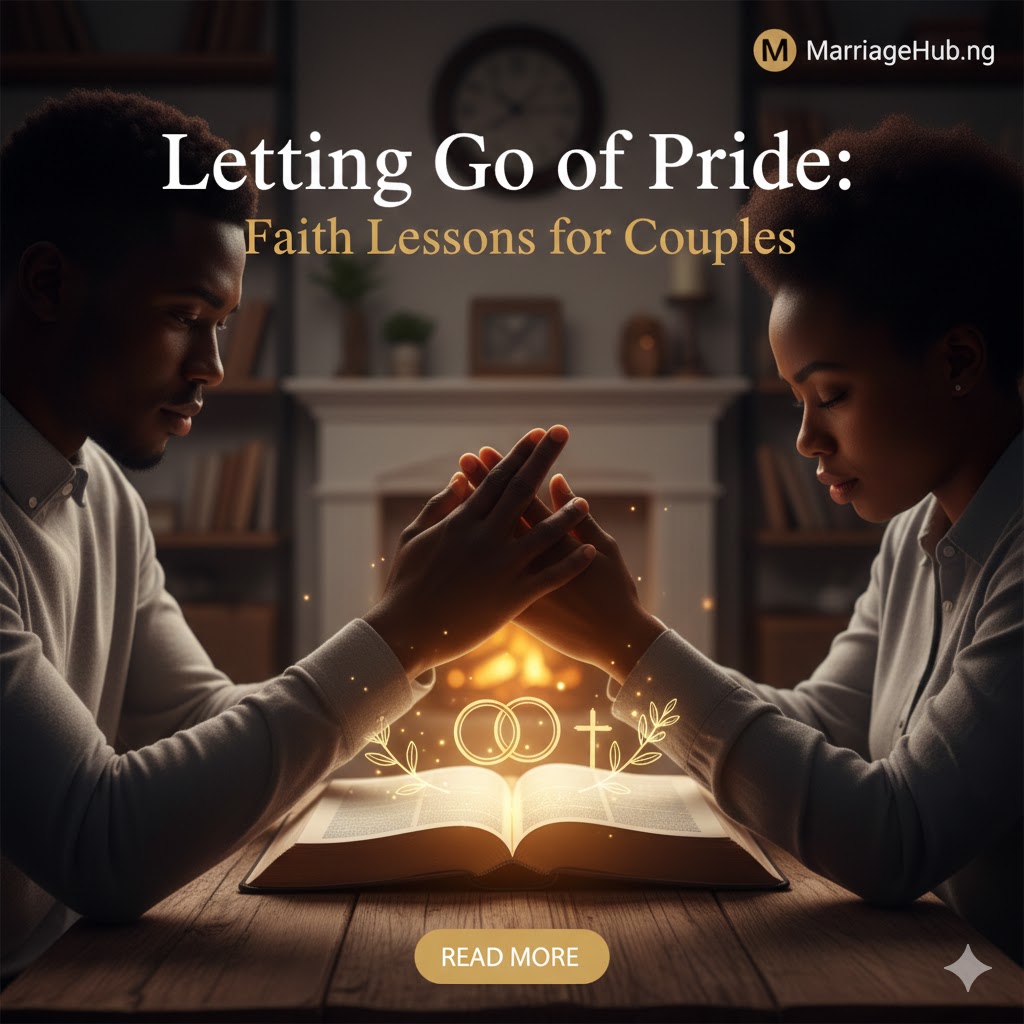
Letting Go of Pride: Faith Lessons for Couples
There's a reason why pride is often called the "silent marriage killer." It doesn't arrive with a warning label or announce its presence. Like a skilled ninja, pride slips into our hearts with practiced stealth and leaves a ransacked marriage in its trail . Before you know it, what began as a minor disagreement about household chores or parenting styles has escalated into a cold war that lasts for days.
The Bible has strong words about pride. In James 4:6, we read, "God opposes the proud but gives grace to the humble" . Think about the weight of that statement. The Creator of the universe, the Author of love itself, actively opposes those who operate in pride. If God is against pride, and marriage is designed by God, then pride working unchecked in a marriage is courting disaster .
Yet humility doesn't come naturally to any of us. We're hardwired for self-preservation, for defending our territory, for making sure our voice is heard. But here's the truth that can transform your marriage: letting go of pride isn't losing—it's winning the right way .
In this article, we'll explore what pride looks like in marriage, why it's so destructive, and most importantly, how faith in Christ provides both the example and the power to choose humility instead.
Part I: Understanding Pride in Marriage
What Pride Looks Like in Everyday Marriage
Pride in marriage rarely announces itself as "I am a proud person." Instead, it manifests in subtle, everyday attitudes and behaviors. According to Proverbs 17:19, "He who loves transgression loves strife; he who builds a high gate invites destruction" . The image of a "high gate" is powerful—it represents elevating oneself above others and shutting people out.
In practical terms, that "high gate" might look like:
-
Always needing to be right in every disagreement, even about trivial matters
-
Finding it almost impossible to apologize sincerely
-
Keeping mental score of your spouse's mistakes while minimizing your own
-
Defensiveness when your spouse offers feedback or expresses hurt
-
Withholding forgiveness because you want your spouse to "squirm" a little longer
-
Comparing your marriage to others with an attitude of superiority
The Greek word Paul uses for pride is physioo, which means having an inflated view of your own intellect and reason . A physioo husband might think, "Wow, she's so lucky to have me!" A physioo wife might silently wonder, "Where would he be without me?" .
The Deceptive Nature of Pride
One of pride's most dangerous qualities is its deceptiveness. It rarely looks like the cartoonish image of someone loudly boasting about themselves. Instead, it often masquerades as something more acceptable—"standing up for myself," "not being a doormat," or "defending truth."
The Ricucci family, in their teaching on marriage, notes that pride is "perhaps the most deceptive, pervasive, and multifaceted form of sin" . It's the root from which countless other marital problems grow. As one marriage expert observed, when we're captured by pride, we might lash out in self-righteous anger (wrath), withdraw from our responsibilities (sloth), resent our spouse's situation (envy), or indulge in escapist behaviors (gluttony, lust) .
Pride was even what caused Satan to fall from Heaven—he grew prideful and wanted to be like God . If pride could corrupt an angel in God's presence, how much more carefully must we guard against it in our marriages?
Part II: Why Pride Destroys Marriages
Pride Turns Differences into Battles
Every marriage brings together two unique individuals with different backgrounds, personalities, preferences, and perspectives. These differences aren't inherently problematic—in fact, they often make marriages stronger and more interesting. But pride takes these natural differences and transforms them into battlegrounds.
Proverbs 13:10 states plainly, "Where there is strife, there is pride, but wisdom is found in those who take advice" . When pride is operating, every disagreement becomes a test of will. It's no longer about finding the best solution for the family; it's about who wins and who loses.
The problem with this approach is that in marriage, when one "wins," both lose . A marital argument isn't like a tennis match where there's a clear victor. It's more like a rowboat—if one person is trying to go north and the other south, the boat simply spins in circles. Nobody gets where they want to go.
Pride Blocks Forgiveness and Reconciliation
Perhaps nowhere is pride more destructive than in its ability to block forgiveness. You know in your heart that you offended your spouse with that comment about their body, their intelligence, or their family. You realize you hurt them with that remark about their spending habits or their parenting. But something keeps you from admitting wrong and seeking forgiveness .
That "something" is pride.
As Dr. James Dobson explains in his married couples devotional, pride is like a giant roadblock on the highway to forgiveness . You know you're guilty, but you can't get the words out of your mouth. At best, you might mumble an insincere "I'm sorry" while making it clear you don't really want to discuss it further.
The physioo person—the one with an inflated view of themselves—struggles profoundly with two simple words: "I'm sorry" . Yet these might be the most powerful words in any marriage.
Pride Invites God's Opposition
This is the most sobering reality of all. James 4:6 doesn't mince words: "God opposes the proud" . Other translations use words like "resists" or "frustrates." When we operate in pride, we position ourselves directly in the path of God's resistance.
Think about what that means for your marriage. If God is opposing you because of your pride, He's also opposing your efforts to reconcile, your attempts at communication, and your desire for intimacy. Nothing good has or will ever come from opposing God .
The good news is that the verse doesn't end there. It continues: "but gives grace to the humble." The same God who opposes the proud pours out grace on the humble. That grace can transform a struggling marriage into a thriving one.
Part III: Faith Lessons on Humility
Lesson 1: Christ Himself is Our Model of Humility
When we struggle to understand what humility looks like in practice, we need look no further than Jesus Christ. Philippians 2:5-8 describes His example:
"In your relationships with one another, have the same mindset as Christ Jesus: Who, being in very nature God, did not consider equality with God something to be used to his own advantage; rather, he made himself nothing by taking the very nature of a servant, being made in human likeness. And being found in appearance as a man, he humbled himself by becoming obedient to death—even death on a cross!"
If anyone had the right to demand His rights, it was Jesus. He was God in the flesh. Yet He willingly surrendered His divine privileges, took the humble position of a servant, and humbled Himself in obedience to God .
The application for marriage is profound. Dana Che, a marriage coach, poses this challenging question: "Where are you holding on to your 'privilege' in marriage instead of lowering yourself in obedience to God?" .
Every time you choose to apologize first, every time you listen to understand rather than to respond, every time you serve your spouse without keeping score—you are modeling Christ.
Lesson 2: The Beatitudes Blueprint for Marital Happiness
In Matthew 5, Jesus opens His Sermon on the Mount with the Beatitudes—statements about who is truly blessed or happy. Bob and Debby Gass, in their devotional "Marital Happiness," connect these Beatitudes directly to marriage :
"Blessed are the poor in spirit" (Matthew 5:3). The Amplified Version expands this: "Blessed (happy, to be envied) are the poor in spirit (the humble, who rate themselves insignificant)." In marriage, pride that demands its rights brings misery, while humility, self-denial, and considering your spouse's needs brings happiness .
"Blessed are the meek" (Matthew 5:5). Meekness isn't weakness—it's power under control. Handling your spouse's struggles with kindness, sensitivity, and patience is an expression of love that brings healing .
"Blessed are the merciful" (Matthew 5:7). Sooner or later, every spouse inflicts injury on the other. Hurt, disappointment, and anger rise up, followed by a desire to make them pay. But just as revenge begets revenge, mercy begets mercy. Treating your spouse mercifully creates an atmosphere where, when you fail, you'll also obtain mercy .
"Blessed are the peacemakers" (Matthew 5:9). Giving up personal victory to be a peacemaker is the ultimate victory. You'd be eternally lost if Jesus hadn't willingly surrendered His rights for your wrongs .
Lesson 3: Humility is the Foundation of All Marital Virtues
In 1 Peter 3:8, the apostle lists five qualities that should characterize Christian relationships: "unity of mind, sympathy, brotherly love, a tender heart, and a humble mind" . Notice that humility is listed last—not because it's least important, but because it's the foundation upon which the others are built.
As one teacher observes, think about it: What is key to submitting to one another? Humility. Why would someone focus on external appearance rather than inner beauty? Pride, the opposite of humility. Why would a husband not live with his wife in an understanding way? Lack of humility. Showing honor to someone else means taking the spotlight off yourself—humility. To have unity of mind, you need to be willing to give up what you want—humility .
Without humility, none of the other marital virtues can flourish. You cannot have genuine sympathy while pridefully focused on your own hurts. You cannot maintain tenderheartedness while pridefully guarding yourself against vulnerability.
Part IV: Practical Steps to Let Go of Pride
1. Recognize the Warning Signs
You can't address what you don't acknowledge. Betsy St. Amant Haddox suggests asking yourself these diagnostic questions :
-
Are you addicted to attention?
-
Do you refuse to be taught anything by your spouse?
-
Does the thought of submission (in the biblical, mutual sense) bother you?
-
Do you find it almost impossible to apologize?
-
Do you often refuse to ask for help?
-
Is it difficult to even try to see your spouse's point of view in an argument?
If you answered yes to any of these, pride may be operating in your heart.
2. Practice the Language of Repentance
Pete Briscoe offers a simple but profound exercise: practice saying "I'm sorry" . Start in the mirror if you have to. Just move your mouth; make the muscles work. Practice and repeat.
Then, for a more advanced version, add the words: "And I was wrong." And if you want to take it all the way, sincerely and humbly add: "Please forgive me." .
These words are like poison to pride. Every time you speak them, pride loses its grip on your heart.
3. Choose to Lose
Here's a marriage mantra worth adopting: "In love, choose to lose" . This doesn't mean becoming a doormat or never expressing your perspective. It means recognizing that in the economy of marriage, "losing" an argument often means winning something far more valuable—intimacy, trust, and unity.
As the Pirolas wisely observe from their decades of marriage: "When I am winning, WE are usually losing" . The next time you're in a disagreement, ask yourself: "Is being right worth creating distance between us?"
4. Listen to Understand, Not to Respond
Proverbs 18:2 warns, "A fool takes no pleasure in understanding, but only in expressing his opinion" . Most of us listen to formulate our response, not to truly understand where our spouse is coming from.
The next time conflict arises, commit to listening differently:
-
Listen to understand your spouse's perspective
-
Listen to find common ground
-
Listen to show grace where needed
-
Ask genuine questions that help you understand their experience
5. Pray Together About Your Conflicts
One of the most powerful ways to defuse pride is to invite God into your disagreements. Dana Che recommends praying together when conflict arises as one of the best ways to develop discernment and foster stronger unity .
There's something about bowing together before a holy God that puts our arguments in proper perspective. When you're both on your knees, it's hard to maintain a prideful posture.
6. Embrace Empathy
Empathy is the ability to put yourself in your spouse's shoes. But genuine empathy isn't asking, "What would I do if I were my spouse?" It's asking, "What would my spouse do if they were in that situation?" . It's about centering them, not yourself.
When you're struggling with pride toward your spouse, try this: instead of focusing on how their actions affected you, consider what might be going on inside them. What fears, pressures, or wounds might be driving their behavior?
7. Keep Your "Gates" Low
Drawing from Proverbs 17:19, the image of a "high gate" represents shutting people out and elevating yourself above them . In practical terms, keeping your gate low means:
-
Staying approachable, even when you're upset
-
Being transparent about your own struggles and failures
-
Quick to admit when you're wrong
-
Resisting the urge to put up walls
Part V: The Blessings of Humility
God's Grace is Poured Out
James 4:6 promises that while God opposes the proud, He gives grace to the humble . Imagine the Creator of the universe actively pouring out grace on your marriage because of your posture of humility. That grace enables you to love when love doesn't come naturally, to forgive when forgiveness seems impossible, and to persevere when giving up seems easier.
Deeper Intimacy with Your Spouse
Pride creates distance; humility creates intimacy. When both spouses commit to humility, walls come down, defenses are lowered, and true connection becomes possible. You no longer have to perform or pretend. You can be fully known and fully loved.
A Marriage That Reflects Christ to the World
Perhaps the greatest blessing of humility in marriage is this: your marriage becomes a living picture of the gospel. Just as Christ humbled Himself to serve and save His bride (the church), husbands and wives who humble themselves to serve each other display the beauty of the gospel to a watching world .
The ring is not the sole symbol of Christian marriage; rather, it's the cross superimposed on the ring . Christ-like surrender of our uncrucified self promotes marital happiness and bears witness to the transforming power of God's love.
Conclusion: The Choice Before Us
Every day, in countless small moments, you face a choice: pride or humility? Will you insist on your rights, or will you surrender them in love? Will you demand an apology, or will you extend forgiveness first? Will you protect your ego, or will you pursue connection?
The stakes couldn't be higher. Pride destroys marriages; humility heals them. God opposes the proud but pours out grace on the humble. The path of humility isn't easy—it goes against every natural instinct. But it's the path Jesus walked, and it's the path that leads to a marriage that not only survives but thrives.
Letting go of pride isn't losing. It's winning the right way—with and for the one you love.
As you go forward, carry this prayer from Pete Briscoe's devotional:
"God, I pray the language of repentance that ushered me into Your Kingdom would become the native language of my marriage. You promise that when I lack the words, Your Spirit will give them to me; when I struggle to speak, Your Spirit will make me bold. I ask that my apologies would be bold and often—that these apologies would be poison to any pride in my character. Amen."
Reflection Questions for Couples
-
Where have you seen pride create distance in your marriage?
-
In what ways has swallowing our pride blessed us in the past?
-
Where can you let your spouse "win" this week?
-
Is there anything you need to apologize for to your spouse?
-
How can you serve your spouse this week in a way that demonstrates humility?






.jpg)


Sign in to comment