 Nurturing Marriages, Enriching Families!
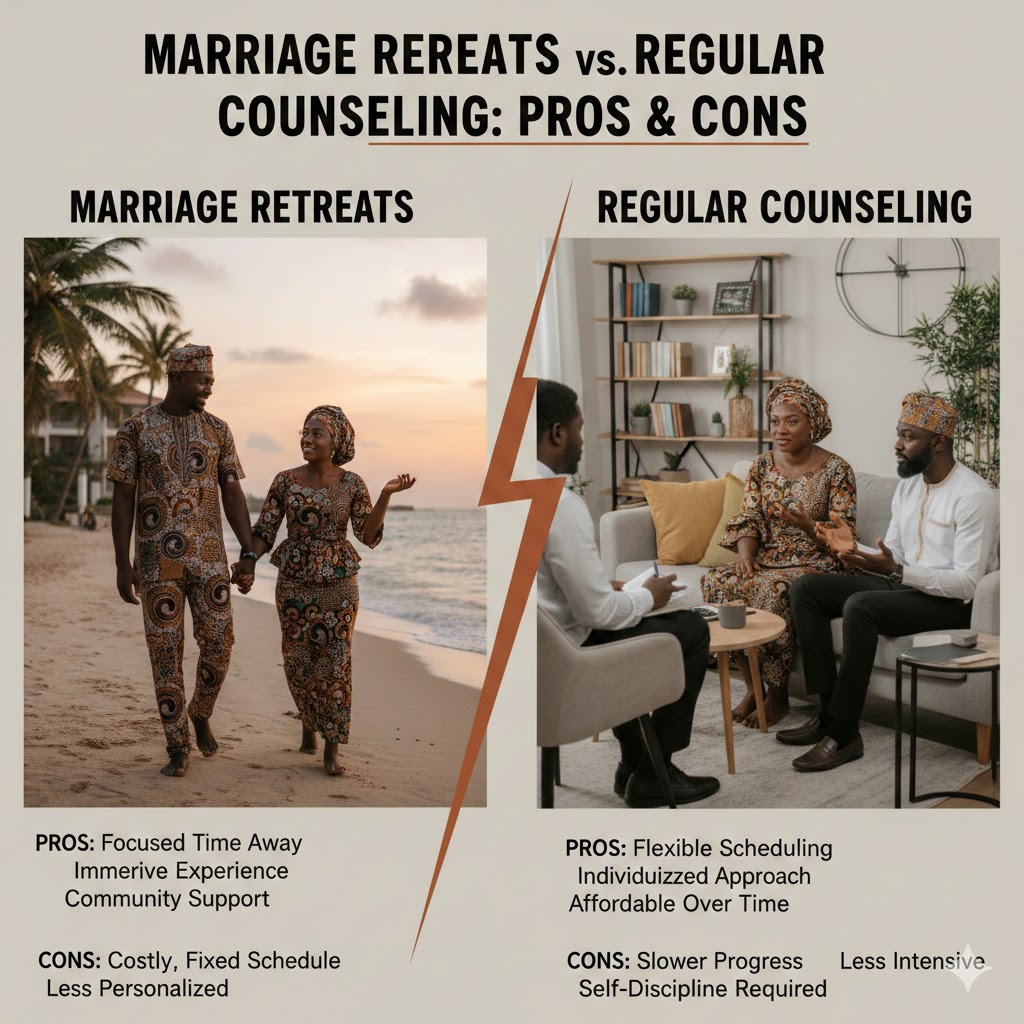
Marriage Retreats vs Regular Counseling: Pros & Cons for Nigerian Couples
Marriage is a journey that requires consistent effort, communication, and emotional connection. Nigerian couples often face unique cultural pressures, extended family involvement, and societal expectations that can strain even the strongest relationships. To maintain or restore marital harmony, many couples consider professional support, either through regular counseling sessions or marriage retreats.
Understanding the differences, advantages, and drawbacks of these approaches is critical in choosing the method best suited for your relationship. This article explores the pros and cons of marriage retreats versus regular counseling, with practical guidance and real-life Nigerian scenarios.
Understanding Regular Counseling
Regular counseling, also called couples therapy, is a structured, ongoing process where couples meet a trained counselor to address challenges, improve communication, and strengthen intimacy. Sessions are typically weekly, biweekly, or monthly.
Key Features:
-
Consistency: Sessions occur over an extended period.
-
Structured Guidance: Counselors guide discussions, exercises, and problem-solving.
-
Progress Monitoring: Couples can track improvements over time.
-
Cultural Sensitivity: Nigerian counselors often incorporate societal norms, family dynamics, and religious beliefs.
Scenario:
In Lagos, Tobi and Sade attended weekly counseling to address communication breakdown and parenting conflicts. Over several months, they gradually rebuilt trust and improved emotional intimacy.
Understanding Marriage Retreats
Marriage retreats are intensive workshops or getaways designed to strengthen relationships. Retreats often occur over a weekend or several days and include seminars, group exercises, and activities that foster emotional and relational growth.
Key Features:
-
Immersive Experience: Couples focus exclusively on their relationship.
-
Hands-On Activities: Exercises may include trust-building, communication drills, and intimacy workshops.
-
Expert Facilitation: Conducted by trained counselors or relationship coaches.
-
Networking Opportunities: Couples can interact with other couples facing similar challenges.
Scenario:
In Abuja, Amaka and Chidi attended a weekend marriage retreat focused on trust and intimacy. The retreat included workshops, guided conversations, and shared exercises that helped them reconnect emotionally.
Pros of Regular Counseling
1. Long-Term Support
-
Regular sessions provide ongoing guidance, allowing couples to address issues gradually and sustainably.
Scenario:
In Port Harcourt, Chika and Emeka resolved financial and parenting conflicts over six months of weekly sessions, ensuring lasting improvements.
2. Personalized Attention
-
Counselors tailor sessions to the couple’s specific challenges, needs, and cultural context.
Scenario:
In Lagos, Sade and Tobi received advice specific to their religious beliefs and family pressures, which increased the relevance of guidance.
3. Structured Problem-Solving
-
Counseling provides step-by-step approaches to conflict resolution, emotional regulation, and communication skills.
Scenario:
In Abuja, Amaka and Chidi learned reflective listening and compromise exercises that addressed recurring arguments effectively.
4. Confidential and Private
-
Counseling sessions are confidential, allowing couples to discuss sensitive topics without public scrutiny.
Scenario:
Chika and Emeka in Port Harcourt appreciated the privacy when discussing financial stress and parenting disagreements.
5. Flexibility in Scheduling
-
Couples can choose weekly, biweekly, or monthly sessions to suit work and family commitments.
Scenario:
In Lagos, Tobi and Sade scheduled sessions around their work and children’s school routines, ensuring consistency without disruption.
Cons of Regular Counseling
1. Slower Progress
-
Results may take weeks or months to become noticeable.
Scenario:
In Abuja, Amaka initially felt frustrated that trust rebuilding with Chidi required sustained effort over several months.
2. Requires Consistent Commitment
-
Both partners must actively participate, practice exercises at home, and attend sessions regularly.
Scenario:
In Port Harcourt, Emeka’s sporadic attendance slowed progress, frustrating Chika and delaying improvements.
3. Less Immersive Experience
-
Counseling is often limited to one or two hours per week, which may not allow intensive focus on deeper issues.
Scenario:
In Lagos, Sade felt sessions were too short to address all emotional concerns, requiring supplementary exercises at home.
Pros of Marriage Retreats
1. Intensive Focus
-
Retreats provide uninterrupted time to focus solely on the relationship.
Scenario:
In Abuja, Amaka and Chidi benefited from a three-day retreat where all distractions were removed, allowing deep emotional connection.
2. Structured and Experiential Learning
-
Retreats include hands-on activities, workshops, and role-playing exercises that teach practical skills.
Scenario:
Chika and Emeka participated in a retreat with communication exercises that simulated real-life parenting conflicts, preparing them for practical application at home.
3. Emotional Reconnection
-
Immersion and shared experiences often lead to immediate emotional bonding and intimacy.
Scenario:
During a Lagos weekend retreat, Tobi and Sade engaged in exercises that reignited emotional closeness, making them feel more connected than in months.
4. Networking and Community Support
-
Couples interact with others facing similar challenges, reducing isolation and fostering support.
Scenario:
At an Abuja retreat, Amaka and Chidi shared experiences with other couples, learning alternative approaches to parenting and discipline conflicts.
5. Intensive Problem Resolution
-
Retreats often address multiple issues simultaneously, offering a holistic approach to marriage improvement.
Scenario:
Chika and Emeka resolved communication, intimacy, and parenting issues in one intensive retreat, jumpstarting positive change.
Cons of Marriage Retreats
1. Limited Follow-Up
-
Retreats are short-term, and couples may struggle to maintain progress without continued support.
Scenario:
In Lagos, Tobi and Sade found it challenging to sustain new habits after the retreat, requiring regular counseling afterward.
2. Cost and Accessibility
-
Retreats can be expensive and require travel, which may not be feasible for all Nigerian couples.
Scenario:
Amaka and Chidi needed to travel from Abuja to a retreat location, incurring significant costs and time away from work.
3. Intense Emotional Experience
-
Retreats can surface unresolved trauma or conflict, which may be overwhelming without ongoing support.
Scenario:
In Port Harcourt, Chika initially felt emotionally drained after confronting past betrayals in an intensive retreat session.
4. Less Personalization
-
Retreats are often designed for groups and may not fully address specific, nuanced challenges unique to a couple.
Scenario:
Sade and Tobi noticed some workshop exercises didn’t align perfectly with their cultural or religious values.
Choosing Between Counseling and Retreats
Consider Regular Counseling If:
-
You need long-term guidance and gradual improvement.
-
You face ongoing conflicts that require sustained support.
-
Privacy and confidentiality are critical.
-
You prefer flexible scheduling to accommodate work and family.
Scenario:
In Abuja, Amaka and Chidi continued weekly counseling to monitor progress after a brief retreat, ensuring lasting change.
Consider Marriage Retreats If:
-
You want an immersive experience to jumpstart intimacy or resolve multiple issues.
-
You seek structured activities and experiential learning.
-
You desire immediate reconnection and shared emotional bonding.
-
You can afford the time, cost, and travel commitment.
Scenario:
In Lagos, Tobi and Sade attended a weekend retreat to intensively work on emotional and physical intimacy before continuing with regular counseling sessions.
Combining Both Approaches
Many couples benefit from combining retreats and regular counseling:
-
Attend a retreat for immersion, bonding, and skill-building.
-
Continue with regular counseling to maintain progress and address ongoing challenges.
Scenario:
Chika and Emeka attended a weekend retreat to reconnect emotionally and then engaged in weekly counseling sessions to resolve parenting conflicts and ensure long-term stability.
Real-Life Nigerian Success Stories
Case Study 1: Tobi and Sade, Lagos
-
Challenge: Communication breakdown and emotional disconnection.
-
Approach: Attended a weekend retreat followed by regular counseling.
-
Outcome: Emotional intimacy improved during the retreat, while counseling helped maintain consistent communication, resolve parenting conflicts, and rebuild trust.
Case Study 2: Amaka and Chidi, Abuja
-
Challenge: Parenting conflicts and trust issues.
-
Approach: Began with counseling to identify root problems, then attended a retreat for immersive skill-building.
-
Outcome: Learned strategies for co-parenting, conflict resolution, and emotional reconnection, with continued counseling ensuring long-term application.
Tips for Maximizing Effectiveness
-
Set Clear Goals: Identify what you hope to achieve before counseling or attending a retreat.
-
Commit Fully: Engage in exercises, discussions, and follow-ups.
-
Apply Techniques at Home: Regular practice ensures sustainability.
-
Seek Culturally Sensitive Support: Nigerian counselors understand family dynamics, religious expectations, and societal norms.
-
Evaluate Progress: Regularly assess whether the approach is helping and adjust accordingly.
Scenario:
In Port Harcourt, Chika and Emeka tracked progress after a retreat and counseling, adjusting strategies to better fit parenting and financial challenges.
Conclusion: Which Approach Is Right for Your Marriage?
Both marriage retreats and regular counseling have distinct advantages and limitations. The choice depends on:
-
Time availability
-
Financial resources
-
Severity and type of marital issues
-
Desire for immersive vs. gradual support
-
Need for confidentiality or community learning
For many Nigerian couples, the most effective approach is a combination: use retreats for intensive bonding and skill-building, complemented by ongoing counseling for sustained progress and support.
Final Thought: Marriage support, whether through retreats or counseling, is a proactive investment in love, communication, and family harmony. Nigerian couples who commit to either or both approaches often experience stronger relationships, improved intimacy, and healthier parenting outcomes.





.jpg)

Sign in to comment