 Nurturing Marriages, Enriching Families!
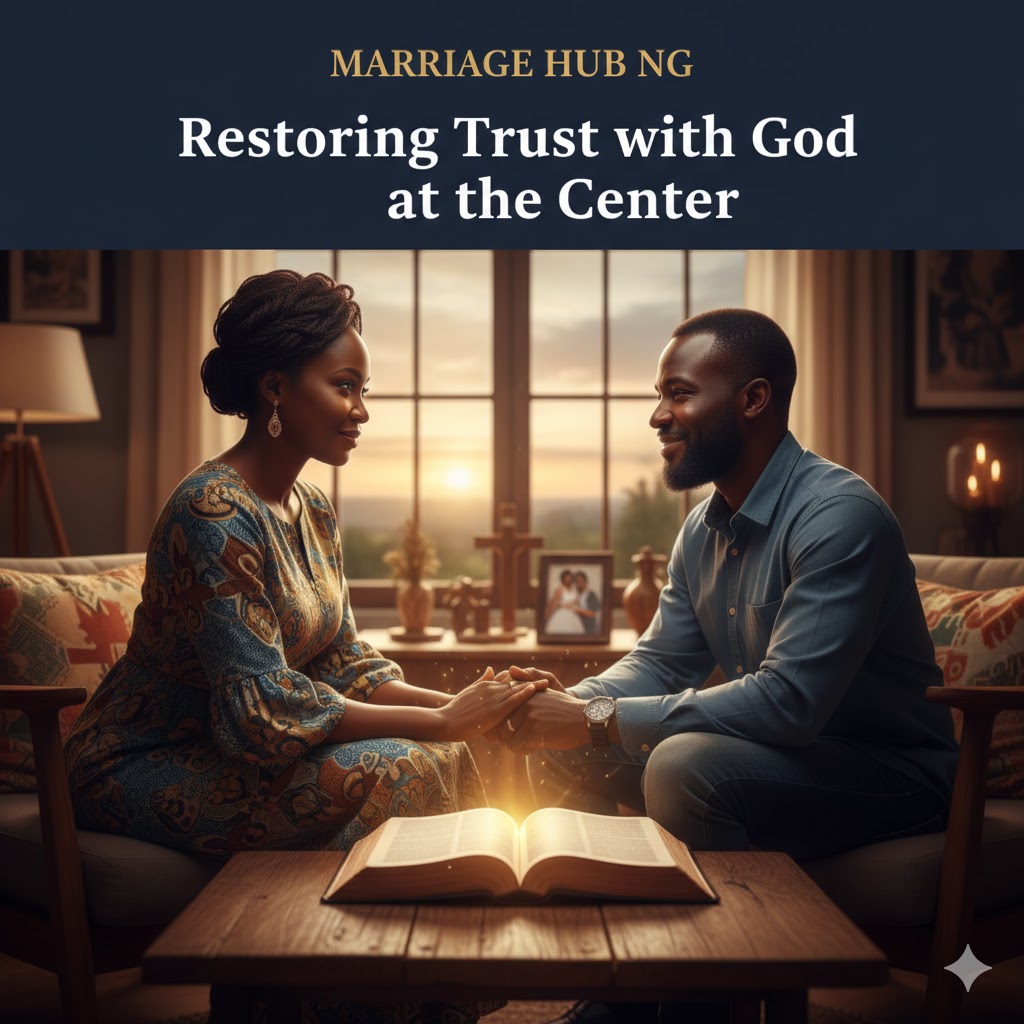
Restoring Trust with God at the Center
Trust is the currency of every relationship. It's the quiet assurance that your spouse means what they say, that their word is their bond, that their heart is safe. When trust is broken—whether through infidelity, deception, financial betrayal, or years of accumulated small dishonesties—something fundamental shatters. You find yourself walking on eggshells, second-guessing every statement, searching for hidden meanings in ordinary conversations.
Trust broken feels like death. And in a very real sense, it is. The death of the relationship you thought you had. The death of security. The death of innocent belief in another person's goodness.
But here's what faith offers that the world cannot: the God of resurrection specializes in bringing life from death. The same power that rolled away the stone from Jesus's tomb is available to roll away the stone from your buried trust.
Yet restoring trust isn't magic. It isn't simply "forgive and forget." It isn't pretending the past didn't happen. Biblical trust restoration is a journey—a sometimes long and painful journey—that requires two willing hearts and a God who specialises in making all things new.
This article explores how to restore trust in marriage with God firmly at the center: not as an afterthought, not as a religious decoration, but as the foundation, the architect, and the ultimate source of the restoration you seek.
Part I: Understanding Trust from a Biblical Perspective
What Trust Really Means
In our modern usage, "trust" has become a thin word. We trust that the restaurant will have our reservation ready. We trust that the bank won't lose our money. We trust that the weather forecast is accurate.
But biblical trust—the word batach in Hebrew, pisteuo in Greek—runs infinitely deeper. It carries the weight of total reliance, confident dependence, and the willing surrender of self-protection. It's the trust a child has when jumping into a parent's arms, eyes closed, fully confident of being caught.
When the Bible speaks of trusting God, it uses this language of complete dependence. Proverbs 3:5-6 commands, "Trust in the Lord with all your heart and lean not on your own understanding; in all your ways submit to him, and he will make your paths straight." Notice the "all" and the "lean not." Biblical trust excludes self-reliance. It's all-in or it's not trust at all.
In marriage, trust should mirror this. It's the confident reliance that your spouse has your best interests at heart, that they'll protect your vulnerability, that they'll remain faithful to their commitments. When that's broken, you don't just lose confidence in your spouse—you lose the ability to trust anything, including sometimes God Himself.
Trust as Covenant, Not Contract
Western culture views relationships through the lens of contracts. You do X, I'll do Y. If you break the terms, the contract is void. This transactional mindset seeps into marriage and poisons the very concept of trust.
But biblical marriage is covenant, not contract. A contract protects your interests; a covenant binds your hearts. A contract says, "I'll love you as long as you deserve it"; a covenant says, "I'll love you even when you don't." A contract has escape clauses; a covenant has staying power.
Malachi 2:14 calls marriage "the covenant of your ancestors." God's relationship with Israel is consistently described as covenant—a binding commitment not based on Israel's faithfulness but on God's faithful character. Even when Israel betrayed Him repeatedly, God remained committed.
This doesn't mean covenant tolerates abuse or requires you to trust an untrustworthy person. But it does mean that restoring trust isn't primarily about renegotiating terms; it's about rebuilding the covenantal bond that was broken.
God's Track Record with Untrustworthy People
Here's the hope that should anchor your journey: God has a proven track record of restoring trust with unfaithful people. The entire Bible is the story of God pursuing, forgiving, and restoring people who broke His heart.
Consider:
-
Abraham, the father of faith, twice lied about Sarah being his sister, endangering her and God's promise. God didn't discard him; He reaffirmed the covenant.
-
Jacob deceived his father, stole his brother's birthright, and spent years running from consequences. God pursued him, wrestled with him, and renamed him Israel.
-
David committed adultery and murder, yet God called him "a man after my own heart" and continued the covenant through his line.
-
Peter denied even knowing Jesus three times—after walking with Him for three years. Jesus restored him and entrusted him with leading the church.
If God can restore trust with these spiritual giants after their catastrophic failures, He can restore trust in your marriage. Your situation is not beyond His reach.
Part II: The Foundation—God at the Center
Why God Must Be Central
Many marriage restoration efforts fail because they make the marriage itself the center. Couples think, "If we just try harder, communicate better, or love more deeply, we can fix this." While these matter, they're insufficient because they miss the fundamental truth: a marriage centered on itself will always collapse under its own weight.
When God is at the center, something shifts. Your ultimate hope isn't in your spouse's changed behavior or your ability to forgive. Your ultimate hope is in a God who is faithful when humans fail, who is trustworthy when trust is broken, who is the same yesterday, today, and forever (Hebrews 13:8).
The Ricucci family, in their teaching on marriage, emphasizes that "a marriage rooted in the gospel is a marriage that can survive anything" because it's built on something more solid than human performance. It's built on the unchanging character of God.
The Trinity as a Model for Trust
Here's a profound truth: trust isn't something God merely commands; it's something God experiences within Himself. The Trinity—Father, Son, and Holy Spirit—exists in eternal, perfect, mutual trust and love. Jesus repeatedly spoke of doing only what He saw the Father doing (John 5:19), trusting the Father's will completely. The Spirit glorifies the Son and points to the Father (John 16:14), existing in perfect relational harmony.
Your marriage, created in the image of God (Genesis 1:27), is designed to reflect this divine dance of mutual trust, love, and self-giving. When trust is broken, you're not just repairing a human relationship—you're restoring an icon of God's own nature.
This elevates the stakes. It also elevates the hope. The same God who exists in perfect relational unity can restore relational unity in your marriage.
Making God the Center Practically
Saying "God is at the center" is easy. Living it requires intentional practices:
-
Individual surrender: Each spouse must daily surrender their rights, their hurts, their expectations to God. This isn't a one-time event but a moment-by-moment choice.
-
Couple prayer: Praying together, especially when trust is broken, feels vulnerable and awkward. Do it anyway. There's something about kneeling before God together that reminds you you're on the same side.
-
Scripture immersion: Fill your mind with God's truth about forgiveness, restoration, and His faithful character. What you feed grows; what you starve dies.
-
Worship together: Singing praises to God—even when you don't feel like it—shifts focus from your pain to His greatness.
-
Community accountability: Surround yourselves with believers who will speak truth, offer support, and hold you both accountable.
When God is truly central, your marriage becomes a three-stranded cord that "is not quickly broken" (Ecclesiastes 4:12).
Part III: The Journey of Restoring Trust
Stage 1: Acknowledging the Breach
Restoration cannot begin until the breach is fully acknowledged. This means:
For the offending spouse:
-
No minimizing: "It wasn't that bad."
-
No blaming: "If you had been more loving, I wouldn't have..."
-
No defending: "I had my reasons."
-
No hiding: Trickle-truthing—revealing just enough to avoid full disclosure—destroys trust further.
Proverbs 28:13 is clear: "Whoever conceals their sins does not prosper, but the one who confesses and renounces them finds mercy." Full confession opens the door to mercy.
For the wounded spouse:
-
Honest acknowledgment of the pain without minimizing or magnifying
-
Willingness to name exactly what was broken
-
Refusal to pretend things are okay when they're not
Psalm 32 describes the agony of unconfessed sin—the groaning, the wasting away. This applies to both spouses: the offender carrying secret guilt, the wounded carrying secret pain. Bringing it into the light is the first step toward healing.
Stage 2: Building a Foundation of Truth
If lies destroyed trust, truth must rebuild it. This means creating an environment of radical honesty going forward.
The offending spouse must commit to:
-
Complete transparency: Open phone, open accounts, open schedule. Nothing hidden.
-
Immediate honesty: Even about small things. Trust is rebuilt one truthful moment at a time.
-
Volunteering information: Not waiting to be asked, but proactively sharing.
-
Answering questions patiently: The wounded spouse may need to ask the same questions repeatedly. Answer each time with grace.
The wounded spouse must commit to:
-
Believing evidence of change, not assuming the worst
-
Not using the past as a weapon in every disagreement
-
Giving opportunities for trust to be demonstrated
Jesus said in John 8:32, "Then you will know the truth, and the truth will set you free." Truth-telling creates the environment where freedom—including freedom from suspicion—becomes possible.
Stage 3: Establishing Healthy Boundaries
Trust restoration isn't about becoming naive. Biblical wisdom includes appropriate boundaries. Proverbs 22:3 notes, "The prudent see danger and take refuge, but the simple keep going and pay the penalty."
Healthy boundaries might include:
-
Temporal boundaries: Timeframes for rebuilding trust, not expecting instant restoration
-
Relational boundaries: Limits on contact with people or situations that enabled the betrayal
-
Accountability boundaries: Regular check-ins with a mentor, counselor, or accountability partner
-
Privacy boundaries: Appropriate transparency without unhealthy control
Boundaries aren't punishment; they're protection. They create a safe container within which trust can gradually grow.
Stage 4: Consistent Faithfulness Over Time
Trust isn't rebuilt through grand gestures or emotional promises. It's rebuilt through thousands of small, consistent, faithful choices over time.
The offending spouse must demonstrate:
-
Reliability: Doing what you said you'd do, when you said you'd do it
-
Faithfulness: Remaining true to commitments, even in small matters
-
Integrity: Being the same person in private as in public
-
Patience: Understanding that trust takes time and not demanding instant results
Jesus highlighted the importance of small faithfulness in Luke 16:10: "Whoever can be trusted with very little can also be trusted with much." Each small act of faithfulness is a brick in the rebuilt wall of trust.
Stage 5: Inviting God Into the Process
Throughout this journey, God must be actively invited into every step:
-
Pray over conflicts before they escalate
-
Ask for wisdom when you don't know what to do (James 1:5 promises He'll give it generously)
-
Confess to God when you struggle to forgive or to trust
-
Thank Him for every sign of progress, no matter how small
-
Worship together even when it feels awkward
The psalmist modeled this continual dependence: "Trust in him at all times, you people; pour out your hearts to him, for God is our refuge" (Psalm 62:8).
Part IV: The Role of Forgiveness in Trust Restoration
Forgiveness and Trust Are Not the Same
A critical distinction must be made: forgiveness and trust are not the same thing. Confusing them creates enormous problems.
-
Forgiveness is a decision to release the debt, to give up your right to revenge, to pardon the offense. It's required of every Christian, regardless of the offender's response. It's a gift you give—not because someone deserves it, but because you've been forgiven by God (Ephesians 4:32).
-
Trust is something that must be earned through consistent, trustworthy behavior over time. It's not a gift; it's a response to demonstrated trustworthiness. You can forgive someone completely and still not trust them—especially if their behavior hasn't changed.
Dana Che, a marriage coach, puts it this way: "Forgiveness says, 'I release you from the debt you owe me.' Trust says, 'I believe you're safe to be vulnerable with again.'" These are different things, restored on different timelines.
Forgiveness as the Foundation for Trust
While forgiveness and trust aren't the same, forgiveness is the necessary foundation for trust restoration. Why? Because unforgiveness keeps you chained to the past, constantly rehearsing the offense, perpetually viewing your spouse through the lens of their worst moment.
When you forgive, you're not saying, "What you did doesn't matter." You're saying, "I'm choosing to release this to God so it doesn't poison my future." This freedom allows you to see your spouse as more than their worst act—which is essential if trust is ever to be rebuilt.
The Daily Choice of Forgiveness
Forgiveness is rarely a one-time event. It's often a daily—sometimes hourly—choice, especially in the early stages of restoration. Every time the pain resurfaces, every time a memory triggers fresh hurt, you face the choice: will I rehearse the offense or release it again?
Jesus told Peter to forgive "seventy-seven times" (Matthew 18:22)—a number meaning unlimited forgiveness. This applies to marriage restoration. You may need to forgive the same offense repeatedly as its full weight gradually surfaces.
Part V: Practical Tools for the Journey
For the Wounded Spouse
-
Give yourself permission to grieve. You've suffered real loss. Grief is the path to healing, not the enemy of it.
-
Don't ignore red flags. While working toward trust, pay attention to your gut. If something feels off, investigate with wisdom.
-
Find your identity in Christ, not your spouse's behavior. You are a beloved child of God regardless of what your spouse does or doesn't do.
-
Practice gratitude. Even in pain, look for God's gifts. Gratitude rewires your brain toward hope.
-
Celebrate every step forward. Trust grows when you notice and affirm progress.
For the Offending Spouse
-
Accept full responsibility. No excuses, no blame-shifting, no minimizing.
-
Become a student of your spouse's pain. Learn what specifically hurt them and how you can help heal it.
-
Initiate transparency. Don't wait to be asked; proactively share what they need to know.
-
Be patient with setbacks. Your spouse may have good days and bad days. Both require the same consistent faithfulness from you.
-
Do your own healing work. Something in you allowed you to betray trust. Address it with a counselor, mentor, or coach.
For Both Spouses
-
Get professional help. A good Christian counselor provides tools, perspective, and accountability you can't get on your own.
-
Find community. Isolation feeds shame and despair. Connect with others who will support you both.
-
Read Scripture together. Let God's Word shape your understanding of forgiveness, trust, and restoration.
-
Pray specifically. Name the struggles, fears, and hopes. Ask God for what you need.
-
Remember God's faithfulness. Look back at how God has been faithful in the past. Let it fuel hope for the future.
Part VI: When Trust Can't Be Restored
The Hard Truth
Sometimes, despite best efforts, trust cannot be fully restored—at least not in the way you hoped. This may happen because:
-
The offending spouse refuses genuine repentance
-
The wounded spouse cannot move past the pain
-
The betrayal was so severe or prolonged that the damage is irreversible
-
One or both spouses won't do the necessary work
If this is your situation, hear this clearly: God is not disappointed in you. The God who permitted divorce because of hard-heartedness (Matthew 19:8) understands the reality of living with unrepentant sin or irreparable damage.
Trusting God When You Can't Trust Your Spouse
If your marriage cannot be restored, your call is still to trust God. This doesn't mean pretending everything is fine or staying in an unsafe situation. It means:
-
Entrusting your future to God, believing He has a plan for your life (Jeremiah 29:11)
-
Refusing bitterness, even when you can't reconcile (Hebrews 12:15)
-
Finding your ultimate security in God, not in any human relationship
-
Allowing God to write a new chapter in your story
The psalmist modeled this: "When I am afraid, I put my trust in you. In God, whose word I praise—in God I trust and am not afraid. What can mere mortals do to me?" (Psalm 56:3-4). Your ultimate trust belongs to God alone.
Conclusion: The God Who Restores
The journey of restoring trust with God at the center is not a straight line. There will be setbacks, fresh wounds, days when you wonder if anything has really changed. But here's what you can count on: the God who began this good work in you will carry it to completion (Philippians 1:6).
He is the God who restored Peter after denial, who restored David after adultery, who restored Israel after centuries of unfaithfulness. He is the God who specializes in bringing beauty from ashes, hope from despair, and life from death.
Your marriage is not beyond His reach. Your trust is not beyond His restoration. Your future is not beyond His redemption.
"Because of the Lord's great love we are not consumed, for his compassions never fail. They are new every morning; great is your faithfulness" (Lamentations 3:22-23).
Let this be your anchor: His compassions are new every morning. Every day brings fresh opportunity for healing, fresh grace for forgiving, fresh strength for trusting—not just in your spouse, but ultimately in the God who never breaks faith.
And as you learn to trust Him more deeply, you may find that trust in your spouse—slowly, gradually, miraculously—begins to grow as well.
Reflection Questions for Couples
-
Where is your ultimate trust placed—in your spouse's performance or in God's faithfulness?
-
What small acts of faithfulness can you celebrate this week?
-
Are there areas where you need to establish healthier boundaries to protect trust?
-
How can you invite God more intentionally into your trust restoration journey?
-
What would it look like for your marriage to reflect the Trinity's mutual trust and love?
Prayer for Restoring Trust
Faithful God, You alone are completely trustworthy. Your character never changes; Your promises never fail; Your love never ends. We bring our broken trust to You—trust in each other that has been shattered, and sometimes trust in You that has grown shaky in the pain.
Heal what is broken in us and in our marriage. Give us patience for the journey, wisdom for the decisions, and hope for the future. Help the one who broke trust to become truly trustworthy through Your transforming power. Help the one who was wounded to forgive fully while also setting wise boundaries.
Most of all, draw us closer to You. Let our ultimate security be found in Your faithful love, not in any human relationship. And as we learn to trust You more deeply, let that trust overflow into our marriage.
We ask this in the name of Jesus, who was faithful even unto death, and who lives to intercede for us. Amen.








.jpg)


Sign in to comment