 Nurturing Marriages, Enriching Families!
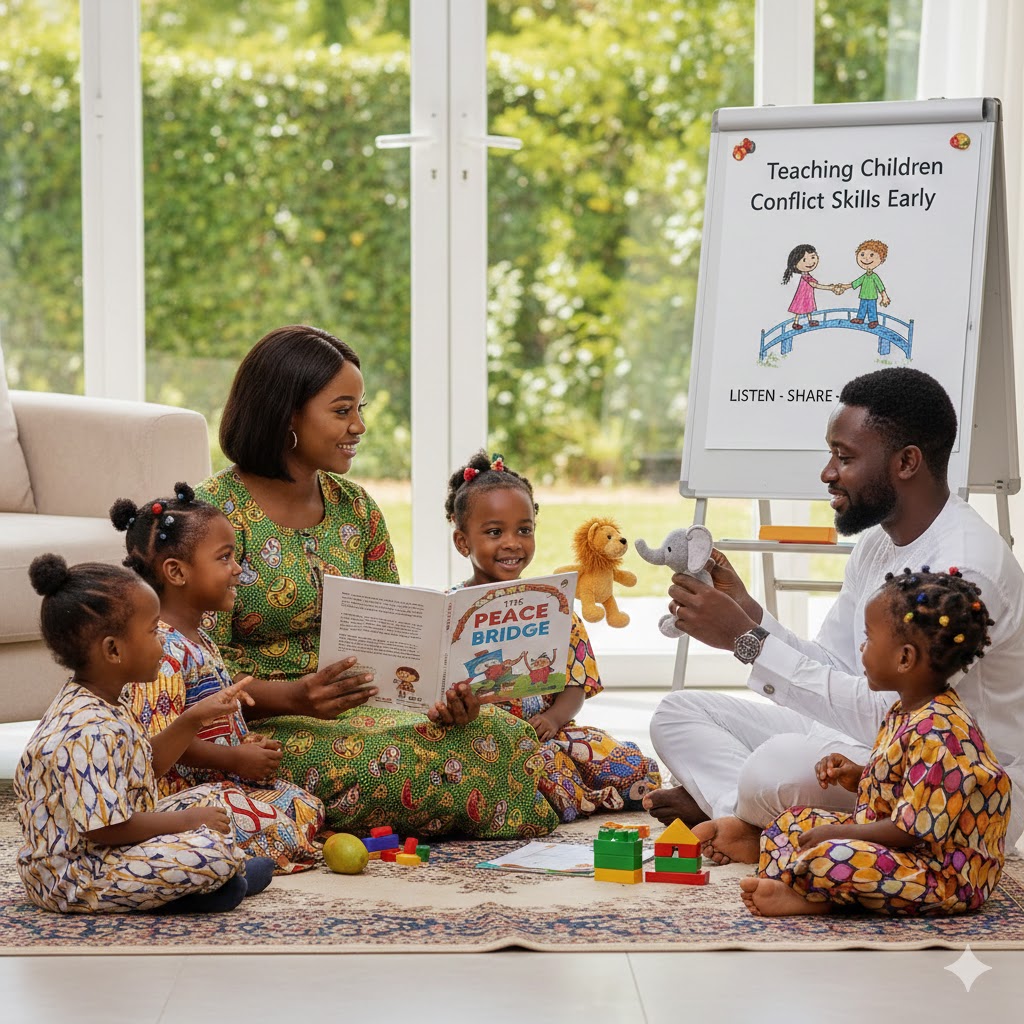
Teaching Children Conflict Skills Early: Building Strong Nigerian Families
Conflict is a natural part of human relationships. From playground squabbles to disagreements at school, children encounter conflict daily. How children respond to conflict early in life shapes their social skills, emotional intelligence, and relationships in adulthood. In Nigerian households, children face unique challenges as they navigate not only peer conflicts but also extended family dynamics, cultural expectations, and religious norms.
Teaching children conflict resolution skills from an early age equips them with empathy, communication, and problem-solving abilities, which are essential for personal growth and healthy relationships. This article explores strategies for teaching conflict skills to Nigerian children, presents real-life scenarios, and provides practical guidance for parents, caregivers, and educators.
Why Early Conflict Education Matters
Children who learn to manage conflict effectively tend to develop:
-
Emotional Intelligence: Understanding their feelings and the feelings of others.
-
Social Skills: Negotiating, compromising, and cooperating with peers and family members.
-
Problem-Solving Abilities: Finding constructive solutions instead of resorting to aggression.
-
Resilience: Handling setbacks without excessive stress or withdrawal.
-
Healthy Relationships: Forming friendships, family bonds, and professional relationships later in life.
Real-Life Scenario: In Lagos, a 7-year-old boy frequently argued with his siblings over toys. His parents enrolled him in a conflict-resolution workshop at school. Over time, he learned to communicate his needs calmly, listen to his siblings, and share effectively. The household atmosphere improved, and siblings became more cooperative.
Nigerian Context: Unique Challenges
1. Extended Family Influence
Many Nigerian children interact regularly with grandparents, aunts, uncles, and cousins. These interactions can create:
-
Competing instructions from different relatives.
-
Pressure to follow elders’ advice without question.
-
Confusion over household rules and expectations.
Teaching conflict skills helps children navigate these relationships respectfully without resorting to rebellion or passive aggression.
Example: In Enugu, a child learned to mediate between cousins who were fighting over household responsibilities, using skills taught by parents to listen, propose solutions, and reach agreements.
2. Cultural Expectations
Nigeria’s diverse cultural landscape often emphasizes respect for elders and collective decision-making. Children may be taught to avoid confrontation, which can lead to:
-
Bottled-up emotions.
-
Passive acceptance of unfair treatment.
-
Difficulty asserting boundaries.
Teaching conflict skills allows children to balance respect with assertiveness, enabling them to handle disputes constructively.
3. School Environment
Children encounter conflicts at school related to:
-
Classroom rules and competition for attention.
-
Peer pressure and bullying.
-
Extracurricular activities and team dynamics.
Conflict-resolution skills help children navigate these challenges without escalating disputes or withdrawing socially.
Real-Life Scenario: In Abuja, a 10-year-old girl faced bullying in school. Using conflict-resolution skills learned at home, she reported the issue calmly, explained her perspective, and negotiated a compromise with teachers and classmates.
Key Conflict Skills for Children
1. Communication Skills
-
Teach children to express feelings using words, not aggression.
-
Encourage the use of “I” statements, such as “I feel upset when…”.
-
Model respectful tone and body language.
Example: In Lagos, parents encouraged a child arguing with a sibling over screen time to say, “I feel frustrated because I want to finish my homework before playing.” This approach prevented shouting matches.
2. Active Listening
-
Children learn to listen to the other person’s perspective without interrupting.
-
Emphasize the importance of empathy and understanding.
-
Practice reflective listening: “So you are saying you want a turn with the toy?”
3. Problem-Solving and Negotiation
-
Teach children to propose win-win solutions.
-
Encourage brainstorming multiple options rather than insisting on one.
-
Reinforce compromise: “If you play for 10 minutes, your sibling can have the next 10 minutes.”
Real-Life Scenario: In Ibadan, a child mediated a dispute between classmates over a group project. Using negotiation skills taught by a parent, the children divided tasks fairly and completed the project successfully.
4. Emotional Regulation
-
Help children identify and manage strong emotions, like anger, jealousy, or frustration.
-
Introduce techniques like deep breathing, counting to ten, or taking a short break.
-
Reinforce that it is okay to feel emotions but not act impulsively.
5. Assertiveness
-
Teach children to stand up for themselves respectfully.
-
Encourage them to express boundaries and rights without being aggressive.
-
Balance assertiveness with cultural and familial norms.
Example: A 9-year-old in Enugu calmly told a cousin, “I need my turn to help in the kitchen. You can go next.” This assertive approach avoided conflict escalation.
6. Conflict Reflection
-
Encourage children to reflect on conflicts after they occur.
-
Ask questions: “What went well?” “What could you do differently next time?”
-
Reinforce learning from mistakes rather than assigning blame.
Strategies for Teaching Conflict Skills in Nigerian Families
1. Start Early
-
Introduce age-appropriate conflict skills during toddler years.
-
Use simple language and role-play scenarios.
-
Praise small successes in managing disagreements.
Real-Life Scenario: In Lagos, parents used role-play to teach a 4-year-old to ask politely for toys instead of grabbing them. Over time, the child internalized the approach and shared toys voluntarily.
2. Model Behavior
-
Children learn by observing parents.
-
Demonstrate calm communication, compromise, and empathy during family discussions.
-
Avoid resolving conflicts with shouting or aggression.
Example: In Abuja, a father mediated a dispute with his spouse respectfully in front of children, explaining the reasoning behind decisions. Children adopted similar conflict-resolution strategies in their interactions.
3. Use Role-Playing
-
Create scenarios reflecting everyday conflicts: toy disputes, sibling arguments, or school disagreements.
-
Encourage children to act out both sides and propose solutions.
-
Discuss outcomes and alternatives.
4. Reinforce Positive Behavior
-
Acknowledge children when they manage conflict well.
-
Use praise or small rewards to reinforce constructive behavior.
-
Avoid punitive measures that discourage dialogue.
5. Incorporate Cultural and Religious Lessons
-
Nigerian culture and religion often provide stories and proverbs emphasizing cooperation, patience, and empathy.
-
Use these narratives to teach conflict skills.
-
Encourage children to apply lessons in real-life situations.
Example: A parent in Enugu used the proverb “It takes two hands to clap” to explain the importance of listening and cooperation during disagreements.
6. Teach Mediation Skills
-
Encourage children to mediate minor disputes among peers or siblings.
-
Provide guidance on fairness, empathy, and compromise.
-
Emphasize neutrality and understanding both sides.
7. Encourage Reflection and Discussion
-
After conflicts, discuss what occurred and potential alternative solutions.
-
Reinforce learning and critical thinking.
-
Emphasize problem-solving over blame.
Real-Life Scenario: A 10-year-old in Lagos reflected on a playground disagreement and discussed ways to approach future conflicts without aggression. Teachers noted improved social interactions and reduced arguments.
8. Use Games and Group Activities
-
Cooperative games teach teamwork, turn-taking, and negotiation.
-
Activities like team sports, puzzles, or collaborative projects reinforce conflict skills.
Example: In Abuja, children participating in a school football team learned compromise and communication when deciding who plays in which position.
Addressing Conflict Skills in Nigerian Schools
Schools play a critical role in shaping children’s ability to manage conflict:
-
Introduce social-emotional learning (SEL) in the curriculum.
-
Train teachers to recognize and guide conflicts constructively.
-
Foster peer mediation programs.
-
Encourage parental involvement in school-based conflict-resolution workshops.
Real-Life Scenario: In Lagos, a school implemented peer mediation clubs where older children guided younger students in resolving playground disputes. Parents reported improved home behavior as children practiced these skills consistently.
Benefits of Teaching Conflict Skills Early
-
Reduced Aggression: Children learn constructive ways to express anger and frustration.
-
Better Academic Performance: Children focus more when emotional conflicts are managed.
-
Improved Peer Relationships: Children form friendships based on empathy and cooperation.
-
Stronger Family Bonds: Less sibling rivalry and household tension.
-
Enhanced Problem-Solving Skills: Children approach challenges thoughtfully and creatively.
-
Preparation for Adulthood: Early conflict skills translate into professional and social success later in life.
Real-Life Scenario: Parents in Ibadan noticed that children who learned early conflict skills handled disagreements in church youth programs, school projects, and family gatherings without parental intervention.
Overcoming Challenges
1. Resistance from Children
-
Some children may struggle to apply skills initially.
-
Solution: Be patient, provide guidance, and practice regularly.
2. Cultural Norms
-
Avoiding conflict with elders can limit children’s ability to assert themselves.
-
Solution: Teach respectful assertiveness, balancing cultural expectations with self-expression.
3. Inconsistent Modeling
-
Parents must consistently model conflict skills.
-
Solution: Commit to demonstrating calm communication, compromise, and empathy at all times.
4. Limited Resources
-
Not all families have access to workshops or professional guidance.
-
Solution: Use home-based role-play, storytelling, and community-based programs.
Conclusion
Teaching children conflict skills early is a cornerstone of healthy family life, emotional intelligence, and social development in Nigeria. By incorporating communication, empathy, problem-solving, and reflection into everyday interactions, parents equip children with lifelong tools to navigate challenges effectively.
In Nigerian households, where extended family dynamics, cultural expectations, and societal pressures are prominent, early conflict education fosters resilient, respectful, and cooperative children. Families that prioritize these skills build stronger bonds, reduce tension, and prepare children for success in school, community, and future relationships.
Investing time in teaching conflict skills is not just about managing disputes—it is about raising capable, empathetic, and confident individuals who contribute positively to Nigerian society.






.jpg)
Sign in to comment