 Nurturing Marriages, Enriching Families!
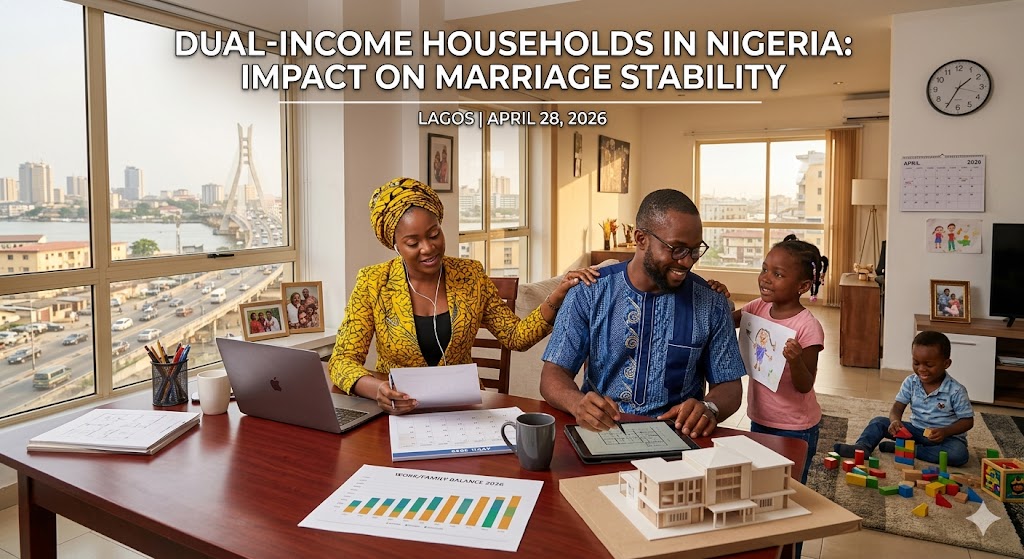
Dual-Income Households in Nigeria: Impact on Marriage Stability
Dual-income households—where both spouses are employed and contribute financially—are becoming increasingly common in Nigeria. Driven by rising living costs, urbanization, education, and changing gender roles, many Nigerian couples now depend on two incomes to sustain their households. While this shift has improved financial resilience for many families, it has also introduced new pressures that affect marriage stability in complex ways.
In cities like Lagos, Abuja, Port Harcourt, and even growing semi-urban areas, dual-income marriages are now the norm rather than the exception. But does earning more together make marriages stronger—or more fragile? The answer lies in how couples manage work stress, communication, expectations, and shared responsibilities.
The Rise of Dual-Income Households in Nigeria
Nigeria’s economic realities have made dual-income households increasingly necessary. Inflation, housing costs, school fees, transportation, and family responsibilities often exceed what a single income can comfortably support.
Research on Nigerian working couples shows that dual-earner families are rapidly increasing due to financial pressure and the need for economic stability.
In many urban households, it is now common for both spouses to work full-time jobs or combine formal employment with side businesses. This shift is especially visible among middle-class families in Lagos and Abuja, where the cost of living is significantly higher than the national average.
What was once seen as an exception is now a survival strategy.
Why Dual-Income Families Are Increasing in Nigeria
Several key factors are driving this shift.
First is economic necessity. A single salary is often insufficient to cover rent, food, education, transportation, healthcare, and extended family obligations.
Second is rising education among women. More Nigerian women are obtaining university degrees and entering the workforce, leading to increased financial independence.
Third is urban lifestyle pressure. In cities, expectations around housing, lifestyle, and social status make dual incomes almost unavoidable.
Finally, cultural transformation is playing a role. The traditional model of a sole male breadwinner is gradually evolving into a partnership-based financial structure.
The Benefits of Dual-Income Households
Despite the challenges, dual-income households offer several advantages that can strengthen marriage stability when well managed.
One of the biggest benefits is financial security. With two incomes, families are better able to handle economic shocks such as job loss, medical emergencies, or inflation spikes. This reduces financial anxiety, which is a major source of marital conflict.
Dual-income households also improve access to better living standards, including improved housing, education for children, and healthcare.
In many cases, financial partnership creates a sense of teamwork. Couples who share financial responsibilities often feel more united in pursuing common goals such as building a home or investing in businesses.
Some studies suggest that shared economic responsibility can strengthen marital cooperation when couples communicate effectively and align expectations.
The Hidden Stress of Dual-Income Marriages
While dual-income households offer financial advantages, they also introduce new forms of stress that can affect marital stability.
One of the most significant challenges is work-life imbalance. Many Nigerian couples work long hours, especially in competitive cities like Lagos. This leaves limited time for emotional connection, intimacy, and family interaction.
A study on dual-earner couples in Nigeria highlights that work stress often spills into home life, creating emotional strain and reducing marital satisfaction.
When both partners return home exhausted, communication often suffers. Small misunderstandings can escalate because emotional patience is low.
Another major issue is role conflict. Traditionally, Nigerian marriages assign household responsibilities primarily to women. However, when both partners work, expectations around domestic chores and childcare often become a source of tension.
Case Study: Lagos Dual-Income Professionals
Consider a young couple living in Ikeja, Lagos. The husband works in banking, while the wife is a digital marketer. Both earn relatively well, but their schedules are demanding.
They leave home early in the morning and return late in the evening. Household chores are often left undone or outsourced. Over time, disagreements begin to emerge—not over money, but over time, attention, and emotional availability.
The wife feels overwhelmed managing both work and home expectations. The husband feels that financial contribution should reduce domestic pressure on him. Without clear communication, resentment builds.
This is a common pattern among dual-income households in urban Nigeria.
Case Study: Abuja Government Worker Family
In Abuja, a civil servant couple illustrates another dimension. Both spouses earn stable incomes, but salary delays and financial planning challenges create stress.
Despite having two incomes, financial pressure arises due to extended family obligations and high living expectations.
The husband feels pressured to meet traditional provider expectations, while the wife expects equal financial responsibility. Misalignment in financial roles leads to periodic conflict.
This shows that dual-income does not automatically eliminate financial stress—it simply changes its nature.
Communication Breakdown in Dual-Income Marriages
One of the most important impacts of dual-income households is reduced communication time.
When couples are busy, conversations often become transactional—focused on bills, schedules, and responsibilities rather than emotional connection.
Over time, this can weaken intimacy. Emotional distance is one of the early warning signs of marital instability.
Without intentional communication, partners may begin to feel like roommates rather than spouses.
Gender Roles and Changing Expectations
Dual-income households challenge traditional gender roles in Nigerian marriages.
Historically, men were expected to provide financially while women managed the home. However, when both partners work, these boundaries become blurred.
Some men still expect traditional domestic roles to remain unchanged despite shared financial responsibility. This creates tension when expectations do not align.
At the same time, women who contribute financially increasingly expect shared household responsibilities, including childcare and domestic tasks.
This shift is one of the most important sources of negotiation—and conflict—in modern Nigerian marriages.
Impact on Marital Satisfaction and Stability
Research indicates that dual-income households can both strengthen and weaken marriages depending on how responsibilities are managed.
When couples share financial goals, communicate effectively, and divide responsibilities fairly, dual-income households can increase stability.
However, when there is imbalance in workload, emotional neglect, or unresolved expectations, stress increases and marital satisfaction declines.
A broader study on marital stability among working women in Lagos highlights that work-family balance is a key predictor of marital satisfaction.
This shows that time management and emotional availability are just as important as income levels.
Economic Pressure and Emotional Burnout
Even though dual-income households earn more, they are not immune to financial stress.
Nigeria’s high cost of living means that two incomes are often required just to maintain basic standards rather than achieve comfort.
This can lead to emotional burnout, where both partners feel constantly pressured to perform at work and at home.
Over time, this stress can reduce patience, increase arguments, and weaken emotional bonding.
Extended Family Pressure in Dual-Income Marriages
In Nigeria, dual-income households often face additional pressure from extended family expectations.
Relatives may assume that two incomes mean greater financial capacity, leading to increased financial demands.
This can create conflict between spouses over budgeting priorities—whether to support immediate nuclear family needs or extended family obligations.
Without agreement, this becomes a recurring source of tension.
Real-Life Insight: Young Entrepreneur Couple
A couple in Port Harcourt runs a small business together while also maintaining separate jobs.
While their combined income is strong, the pressure of managing both business and personal life creates constant fatigue.
They report that the biggest challenge is not money, but time and emotional exhaustion. When business stress overlaps with marital stress, disagreements become frequent.
Their experience shows that dual-income households require not just financial coordination, but emotional teamwork.
Technology and Dual-Income Lifestyle
Technology plays a major role in managing dual-income households in Nigeria.
Mobile banking, digital communication, and remote work tools have made it easier for couples to coordinate finances and responsibilities.
However, technology also contributes to distraction. Excessive screen time and work communication outside office hours can reduce family interaction.
Policy and Economic Implications
The rise of dual-income households has broader implications for Nigerian society.
It highlights the need for workplace policies that support work-life balance, such as flexible working hours and parental leave.
It also underscores the importance of affordable childcare systems, which can reduce domestic stress.
Economic policies that improve income stability and reduce inflation will also directly support family stability.
The Future of Dual-Income Marriages in Nigeria
The future of marriage in Nigeria will likely continue to move toward dual-income partnerships.
As more women join the workforce and economic pressure increases, dual-income households will become even more common.
However, success will depend not just on income levels, but on how couples manage time, expectations, communication, and emotional connection.
Marriages that adapt to shared responsibility models are more likely to remain stable in the long term.
Conclusion
Dual-income households in Nigeria represent both opportunity and challenge. While they provide financial resilience in an increasingly expensive economy, they also introduce new forms of stress related to time, communication, and role expectations.
The stability of such marriages depends not on income alone, but on cooperation, emotional intelligence, and shared understanding.
As Nigeria continues to evolve economically and socially, dual-income households will remain a defining feature of modern marriage. The key to success lies in balance—between work and home, income and intimacy, responsibility and rest.
Users can join groups/tribes on https://www.marriagehub.ng/all-groups or create groups on https://www.marriagehub.ng/create-tribes-group. Users can also purchase products, services and downloadable on https://www.marriagehub.ng/marketplace.
Follow us on
WhatsApp - https://whatsapp.com/channel/0029VbCav9MCcW4pw3GSM72w
X - https://x.com/MarriageHubNG
Facebook - https://web.facebook.com/MarriageHubNigeria
Instagram - https://www.instagram.com/marriagehubng3









.jpg)




Sign in to comment