 Nurturing Marriages, Enriching Families!
Infidelity in Nigerian Marriages: Causes & Consequences
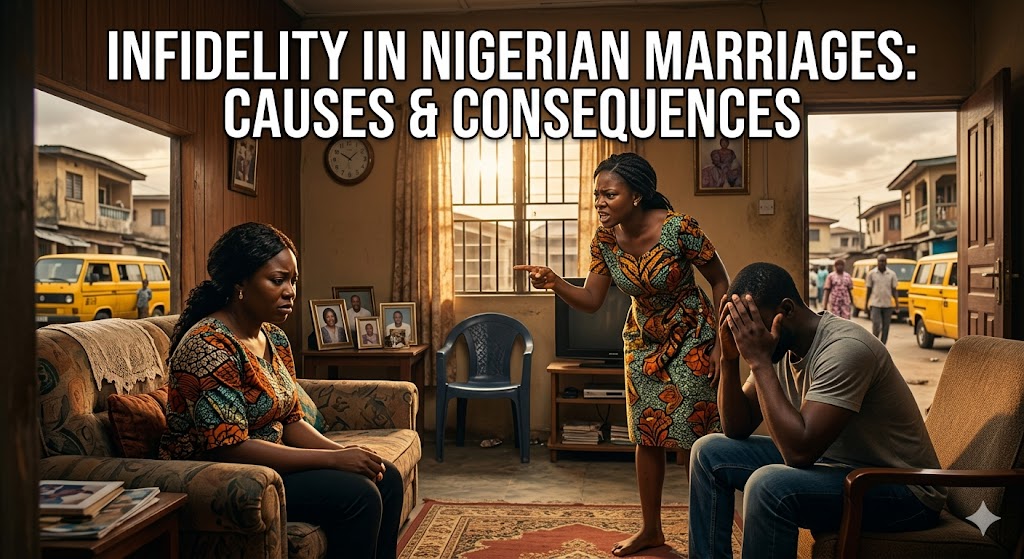
Infidelity—commonly described as the breach of trust through emotional or sexual relationships outside marriage—has become one of the most sensitive and widely discussed issues affecting marriages in Nigeria today. While it is not a new phenomenon, its visibility, frequency, and consequences have intensified in modern times due to social change, urbanization, and shifting relationship expectations. Across cities like Lagos, Abuja, and Port Harcourt, as well as in rural communities, infidelity continues to shape marital stability, family dynamics, and social values.
Understanding infidelity in Nigerian marriages requires going beyond moral judgments to examine its causes, patterns, and far-reaching consequences. It is a deeply layered issue influenced by culture, gender roles, economic realities, and evolving personal expectations.
The Reality of Infidelity in Nigeria
Infidelity is widely acknowledged as a major contributor to marital conflict and breakdown in Nigeria. Studies and social research consistently identify it as one of the leading causes of divorce and separation. Research indicates that infidelity has been responsible for a significant proportion of marital instability, often triggering emotional distress, conflict, and eventual dissolution of marriages.
In recent years, the issue has gained even more attention due to rising cases of paternity disputes and DNA testing. Some researchers note a “rapid and drastic increase” in paternity verification cases, which has been linked to concerns about widespread infidelity within marriages.
Although reliable nationwide statistics are limited, multiple studies across Nigerian states suggest that both men and women engage in extramarital relationships, though the motivations and social perceptions differ significantly.
Cultural Context and Gender Dynamics
Infidelity in Nigeria cannot be fully understood without considering cultural and gender dynamics. Traditionally, Nigerian society has been more permissive of male infidelity, especially in contexts where polygamy is culturally accepted. In some communities, a man’s extramarital relationships may be tolerated as long as he fulfills his responsibilities at home.
For women, however, infidelity carries much stronger social stigma. Cultural expectations often place a higher burden of fidelity on women, linking their behavior to family honor and moral values. This double standard has historically shaped how infidelity is perceived and addressed within marriages.
However, this dynamic is gradually changing. Studies show that infidelity among women is increasing, particularly among educated and working-class women in urban areas. This shift reflects broader changes in gender roles, economic independence, and personal expectations.
Major Causes of Infidelity in Nigerian Marriages
Infidelity rarely occurs in isolation. It is usually the result of multiple overlapping factors that build over time within a relationship.
One major cause is lack of emotional connection. Research among working-class women in Lagos highlights that lack of care, attention, and emotional support from spouses is a key driver of infidelity. When individuals feel neglected or unappreciated, they may seek validation outside the marriage.
Sexual dissatisfaction is another important factor. Studies conducted in places like Ilorin identify lack of sexual fulfillment as a significant contributor to extramarital affairs. In many Nigerian marriages, conversations around sexual needs are often avoided due to cultural or religious sensitivities, leading to unmet expectations.
Economic pressure also plays a critical role. Financial instability can create stress, resentment, and power imbalances within relationships. In some cases, individuals engage in extramarital relationships for financial support, particularly in urban environments where the cost of living is high.
Distance between spouses is another contributing factor. With increasing migration for work—both within Nigeria and internationally—many couples live apart for extended periods. This physical separation can weaken emotional bonds and increase the likelihood of infidelity.
Other causes include early or forced marriages, lack of preparation for marital life, and unresolved personal issues such as depression or low self-esteem. Research also points to revenge and retaliation as motivations, where one partner engages in infidelity in response to perceived wrongdoing by the other.
Childlessness is another sensitive factor. In a society where children are highly valued, the inability to conceive can create tension and dissatisfaction, sometimes leading one or both partners to seek relationships outside the marriage.
Case Studies and Real-Life Insights
Real-life experiences across Nigeria illustrate how infidelity plays out in everyday marriages.
In Lagos, for instance, many professionals struggle with demanding careers that leave little time for nurturing relationships. A common scenario involves couples growing emotionally distant due to long working hours, eventually leading one partner to seek companionship elsewhere.
In southeastern Nigeria, ethnographic research highlights how changing social norms influence infidelity. As young people transition from active premarital social lives into marriage, adjusting to expectations of exclusivity can be challenging.
In northern Nigeria, factors such as early marriage and economic dependency can contribute to marital dissatisfaction, increasing the likelihood of extramarital relationships.
Online discussions also reflect public sentiment. On Nigerian forums, some individuals argue that infidelity is “rampant,” while others emphasize that not all marriages are affected. These mixed perspectives highlight the difficulty of generalizing the issue across a diverse country.
Types of Infidelity in Nigerian Marriages
Infidelity in Nigeria is not limited to physical relationships. It can take multiple forms, including emotional, sexual, and even social infidelity.
Emotional infidelity involves forming deep emotional connections with someone outside the marriage, often through communication and shared experiences. Sexual infidelity involves physical intimacy, while social infidelity may include secretive friendships or relationships that undermine trust.
Research in Delta State categorizes infidelity into these different forms, showing that each type can significantly affect marital stability.
Consequences of Infidelity
The consequences of infidelity extend far beyond the individuals involved, affecting families, communities, and society as a whole.
At the marital level, infidelity often leads to loss of trust, emotional trauma, and conflict. Many couples struggle to rebuild trust after an affair, and in many cases, the relationship eventually ends.
Infidelity is also a major driver of divorce in Nigeria. Studies indicate that it is one of the most common reasons cited in marital breakdown.
For children, the impact can be significant. Exposure to parental conflict and separation can affect emotional well-being, academic performance, and long-term relationships.
Psychologically, individuals affected by infidelity may experience anxiety, depression, and reduced self-esteem. Research highlights that the aftermath of infidelity can have lasting emotional and mental health effects.
Socially, infidelity can damage reputations and strain relationships between extended family members. In Nigeria, where family networks play a central role in marriage, the effects often extend beyond the couple.
In extreme cases, infidelity can lead to domestic violence or legal disputes, particularly in situations involving paternity issues or financial disagreements.
Religion, Morality, and Infidelity
Religion plays a crucial role in shaping attitudes toward infidelity in Nigeria. Both Christianity and Islam strongly condemn adultery, emphasizing faithfulness as a core marital value.
However, the gap between religious ideals and real-life behavior remains a challenge. While many Nigerians uphold religious teachings, the pressures of modern life, combined with personal and societal factors, continue to drive instances of infidelity.
Traditional beliefs also influence how infidelity is handled. In some communities, family elders may intervene to resolve conflicts rather than encouraging divorce, leading to informal reconciliation processes.
Modern Influences and Technology
Technology has introduced new dimensions to infidelity in Nigeria. Social media platforms, messaging apps, and online dating have made it easier for individuals to form connections outside their marriages.
Digital communication allows for discreet interactions, increasing the prevalence of emotional affairs. At the same time, technology also exposes infidelity more quickly, leading to conflicts and confrontations.
Urbanization and globalization have further reshaped relationship expectations. Many Nigerians now seek emotional fulfillment, compatibility, and personal happiness in marriage, raising the stakes for dissatisfaction and potential infidelity.
Can Infidelity Be Prevented?
While infidelity cannot be completely eliminated, certain factors can reduce its likelihood. Strong communication, emotional connection, mutual respect, and financial stability all play important roles in maintaining healthy marriages.
Counselling and relationship education are increasingly recognized as valuable tools for addressing marital challenges. Studies recommend that couples be educated about the causes and consequences of infidelity to help prevent it.
Ultimately, prevention requires intentional effort from both partners to build trust, address issues early, and maintain a strong emotional bond.
Conclusion
Infidelity in Nigerian marriages is a complex and evolving issue shaped by cultural traditions, economic realities, and modern influences. While it remains a major cause of marital instability and divorce, it also reflects deeper challenges within relationships, including unmet emotional needs, communication gaps, and societal pressures.
As Nigeria continues to modernize, the institution of marriage will keep evolving. Addressing infidelity will require not only personal commitment but also broader societal efforts to promote healthy relationships, gender equality, and open communication.
Understanding the causes and consequences of infidelity is the first step toward building stronger, more resilient marriages in Nigeria.
Users can join groups/tribes on https://www.marriagehub.ng/all-groups or create groups on https://www.marriagehub.ng/create-tribes-group. Users can also purchase products, services and downloadable on https://www.marriagehub.ng/marketplace.
Follow us on
WhatsApp - https://whatsapp.com/channel/0029VbCav9MCcW4pw3GSM72w
X - https://x.com/MarriageHubNG
Facebook - https://web.facebook.com/MarriageHubNigeria
Instagram - https://www.instagram.com/marriagehubng3




.jpg)

Sign in to comment