 Nurturing Marriages, Enriching Families!
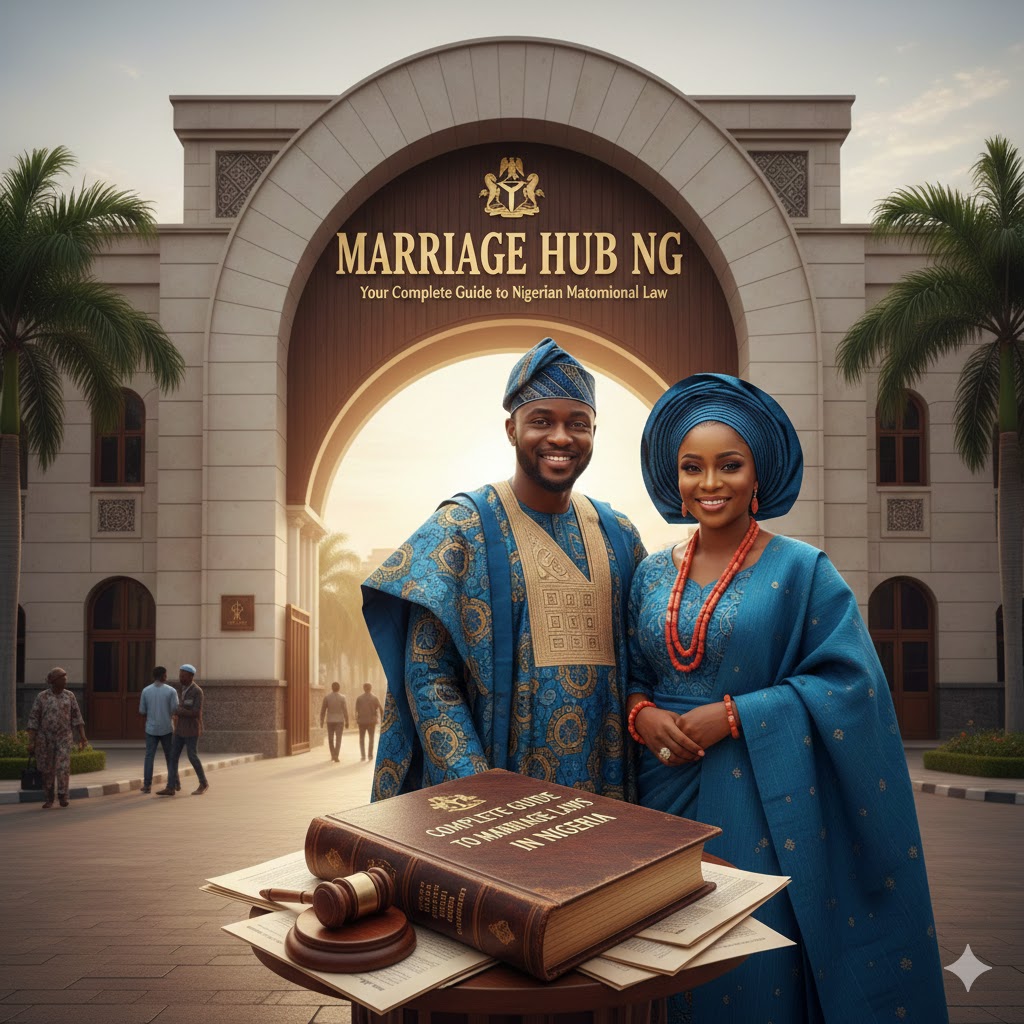
The Complete Guide to Marriage Laws in Nigeria: Rights, Types, and Procedures
Marriage is a sacred institution and a significant legal contract. In Nigeria, a country renowned for its rich cultural and religious diversity, the path to "I do" is governed not by one, but by three parallel legal systems. This pluralistic approach means that the rights, responsibilities, and even the definition of a valid marriage can differ dramatically depending on whether a couple chooses a civil ceremony, follows native law and custom, or marries under Islamic personal law.
For the average Nigerian couple, this legal landscape can be confusing. Many are unaware that the beautiful traditional engagement they just had is a legally binding marriage under customary law. Others mistakenly believe that a church wedding alone is sufficient for a statutory marriage without registry involvement. This lack of clarity can have profound consequences, especially when it comes to matters of inheritance, divorce, child custody, and property rights.
Understanding Nigeria's marriage laws is not just a matter for lawyers and judges; it is essential knowledge for every couple. It empowers you to make informed decisions, protect your rights, and ensure your union is recognized and secure. This guide provides a comprehensive, easy-to-understand overview of the three types of marriage in Nigeria, the legal procedures for each, the rights they confer, and the latest judicial trends shaping family law today. We will explore real statistics, landmark court rulings, and practical advice to help you navigate your own marital journey with confidence.
Table of Contents
-
Introduction: Navigating Nigeria's Plural Marriage System
-
The Three Pillars of Marriage in Nigeria
-
Statutory Marriage (Marriage Act)
-
Customary Law Marriage
-
Islamic Law Marriage
-
-
Statutory Marriage: The Full Legal Guide
-
Key Statistics on Marriage in Nigeria
-
Legal Framework and Governing Acts
-
Eligibility Requirements for a Civil Wedding
-
Required Documents for Registry Marriage
-
The 21-Day Notice Period and Recent Court Rulings
-
The Ceremony and Registration
-
-
Customary Marriages: Tradition and the Law
-
What Makes a Customary Marriage Legal?
-
The Central Role of Bride Price
-
State Regulations and the Push for Reform
-
-
Islamic Marriages: Sharia and Personal Law
-
Legal Framework in Northern Nigeria
-
Key Requirements and Practices
-
-
The "Double-Decker" Marriage: Combining Legal Systems
-
Dissolution of Marriage: Divorce Laws in Nigeria
-
Divorce Under the Matrimonial Causes Act (Statutory Marriage)
-
Dissolution of Customary Marriages and Bride Price Refund
-
Dissolution Under Islamic Law
-
-
Rights of Women and Emerging Judicial Trends
-
Inheritance Rights for Widows
-
Judicial Scrutiny of "Repugnant" Customs
-
-
Frequently Asked Questions (FAQs)
-
Internal Links: Related Resources on MarriageHub.ng
-
Conclusion: Ensuring Your Marriage is Legal and Protected
Introduction: Navigating Nigeria's Plural Marriage System
Getting married in Nigeria is a beautiful and complex affair, deeply rooted in culture, religion, and statutory law. Unlike many countries with a single, uniform marriage code, Nigeria operates a plural legal system. This means that three distinct types of marriage are legally recognized: Statutory Marriage, Customary Marriage, and Islamic Marriage . Each type has its own set of rules, requirements, and legal implications for rights, inheritance, and divorce.
For couples, understanding these differences is not just a legal formality; it is essential for protecting their future and ensuring their union is valid and recognized. A mistake in understanding which laws apply to your marriage can lead to significant complications down the road, especially in matters of inheritance, child custody, or divorce. This comprehensive guide will walk you through everything you need to know about marriage laws in Nigeria, providing facts, figures, and clear explanations to help you make informed decisions.
The Three Pillars of Marriage in Nigeria
Nigeria's marriage law rests on three foundational systems, each with a distinct source and authority.
Statutory Marriage (Marriage Act)
This is the civil marriage governed by the Marriage Act (Cap. M7, Laws of the Federation of Nigeria, 2004) and the Matrimonial Causes Act. It is monogamous (one husband, one wife), conducted in a registry or licensed place of worship, and registered with the government. It offers the strongest legal protection and is the only marriage type automatically recognized internationally .
Customary Law Marriage
This marriage is governed by the native law and customs of the specific ethnic group of the parties (e.g., Yoruba, Igbo, Hausa). It is potentially polygamous (a man can marry more than one wife) and is validated by traditional rites, most notably the payment of bride price. Its validity is based on the customs of the community .
Islamic Law Marriage
This marriage is governed by Islamic personal law (Sharia) and applies in states that have adopted Sharia courts. It is also potentially polygamous (up to four wives) and is conducted according to Islamic rites. It is recognized under the Nigerian constitution as part of the customary law framework for Muslims .
Statutory Marriage: The Full Legal Guide
For many Nigerian and international couples, a statutory marriage is the preferred choice due to its clarity and legal robustness .
Key Statistics on Marriage in Nigeria
Recent data provides a revealing snapshot of modern relationships in Nigeria. The Zikoko State of Love Report (2026) , which surveyed over 10,000 Nigerians, offers key insights :
-
Infidelity: A striking 50% of Nigerians admitted to cheating on a partner at least once, while 59% reported having been cheated on. Regional variations are significant, with Katsina recording the highest infidelity rate (9 in 10) and Kaduna the highest rate of fidelity (8 in 10).
-
Marriage Regret and Resilience: 4 in 10 married Nigerians admit to feeling regret at some point in their marriage. However, 6 in 10 say they are resistant to divorce, even in unhappy relationships.
-
Financial Pressure: An overwhelming 8 in 10 Nigerians report that financial pressure has negatively affected their love life.
-
Undefined Relationships: 62% of Nigerian daters are in relationships without a clearly defined label (situationships), which experts suggest may be fueling infidelity due to ambiguous boundaries.
-
Premarital Sex: Nearly 7 in 10 Nigerians believe premarital sex is acceptable, indicating a shift in social values.
Legal Framework and Governing Acts
A statutory marriage is governed by two main pieces of legislation:
-
The Marriage Act: This act outlines the procedures for contracting a valid marriage, including notice, ceremonies, and registration.
-
The Matrimonial Causes Act: This act governs the dissolution of statutory marriages (divorce) and related matters like child custody and property division. It establishes that a divorce can only be granted by the High Court on the grounds of an irretrievable breakdown of the marriage .
Eligibility Requirements for a Civil Wedding
To enter into a valid statutory marriage, both parties must :
-
Be at least 18 years old.
-
Freely consent to the marriage.
-
Not be legally married to anyone else under statutory law.
-
Not be within prohibited degrees of relationship (e.g., direct blood relatives).
Required Documents for Registry Marriage
Couples intending to marry in a registry must typically submit the following :
-
Valid International Passports or National Identity Cards.
-
Birth Certificates or a sworn Declaration of Age.
-
Certificate of No Impediment to Marriage or an Affidavit of Single Status from a court.
-
Passport-sized photographs.
-
If previously married, a Decree of Divorce or a Death Certificate of the former spouse.
-
Proof of residence, if required.
The 21-Day Notice Period and Recent Court Rulings
Under the Marriage Act, couples must submit a Notice of Intended Marriage to the registry. This notice is publicly displayed for 21 days to allow for any legal objections to the union .
A landmark ruling by the Court of Appeal in Lagos in February 2026 clarified where these marriages can be conducted. The court nullified the idea of exclusive rights, confirming that both Local Government Councils and Federal Marriage Registries are legally empowered to conduct statutory marriages and issue certificates .
The Ceremony and Registration
After the 21-day period, the marriage can be conducted by a licensed registrar in the presence of at least two witnesses. Once the ceremony is completed, the marriage is entered into the official register, and a Marriage Certificate is issued. This certificate is the primary legal proof of the marriage .
Customary Marriages: Tradition and the Law
A customary marriage is not a single, uniform procedure but varies greatly across Nigeria's over 250 ethnic groups.
What Makes a Customary Marriage Legal?
For a customary marriage to be valid, it must comply with the native law and custom of the community the parties belong to. Key elements often include :
-
Consent of the families of both the bride and groom.
-
Payment of bride price (dowry) by the groom or his family to the bride's family.
-
Performance of specific traditional rites (e.g., presentation of drinks, kola nuts, etc.).
The Central Role of Bride Price
Bride price is a core component, symbolizing the groom's commitment and the union of two families. However, Nigerian law is clear: payment of bride price does not confer ownership of the woman; she is not property .
Some states have laws to prevent excessive demands. For example, the Limitation of Dowry Law of 1956, applicable in parts of the Southeast, caps bride price at a nominal amount. In a significant 2025 reform, the Tor Tiv (paramount ruler of the Tiv nation) fixed a maximum of N100,000 for marriage items and abolished certain expensive ceremonies to promote financial responsibility .
State Regulations and the Push for Reform
Customary courts have jurisdiction over matters related to these marriages. There is an ongoing push for reform to better protect rights. In February 2026, the Speaker of the Lagos State House of Assembly emphasized the need to "continually make laws that will benefit the evolving society which protects both partners and children in marriages" under customary law .
Islamic Marriages: Sharia and Personal Law
Islamic marriages are governed by Sharia law and are most common in Northern Nigeria.
Legal Framework in Northern Nigeria
The 1999 Constitution recognizes Sharia courts of appeal. These courts handle personal status matters—including marriage, divorce, and inheritance—for Muslims. Some northern states have expanded Sharia to cover criminal jurisdiction, which has been a point of legal and constitutional debate. Groups like the NDI Igbo Worldwide Union have called on the Federal Government to provide clearer constitutional guidance on the relationship between Sharia and common law to ensure "clarity, equity, and full protection of citizens' rights" .
Key Requirements and Practices
An Islamic marriage (Nikkah) is a contract requiring:
-
Proposal and acceptance.
-
Consent of both the bride and groom (the bride's consent is essential).
-
Payment of a dowry (Mahr) by the groom directly to the bride.
-
Presence of two male Muslim witnesses.
-
A marriage guardian (Wali) for the bride.
The "Double-Decker" Marriage: Combining Legal Systems
It is very common in Nigeria for couples to contract both a customary and a statutory marriage. Legally, this creates a "double-decker" marriage. The key implication is that both marriages must be dissolved separately :
-
The customary marriage must be dissolved through a family process or in a Customary Court.
-
The statutory marriage must be dissolved by a decree from the High Court.
Dissolving one does not automatically dissolve the other.
Dissolution of Marriage: Divorce Laws in Nigeria
The process for ending a marriage depends entirely on how it was contracted.
Divorce Under the Matrimonial Causes Act (Statutory Marriage)
A statutory marriage can only be ended by a decree of divorce from the High Court. The sole ground is that the marriage has broken down irretrievably, which must be proven by facts such as adultery, desertion, or unreasonable behavior . Bride price is legally irrelevant in a statutory divorce, and refund demands have no legal basis.
Dissolution of Customary Marriages and Bride Price Refund
Customary marriages can be dissolved extra-judicially (through family elders) or in a Customary Court. In many customs, particularly Igbo, the refund of the bride price is seen as a symbolic act confirming the marriage has ended . However, this is not an automatic or absolute rule.
-
Refunds are often partial, negotiated based on the length of the marriage and whether children were born.
-
Emerging judicial trends are questioning the fairness of mandatory refunds. Recent decisions (2022-2024) from Upper Customary Courts in Kaduna suggest that demanding a full refund after a very long marriage, where the woman contributed decades of unpaid labor and raised children, may be unjust and rejected by courts . This reflects a growing emphasis on equity and human dignity over rigid custom.
Dissolution Under Islamic Law
Divorce under Islamic law can be initiated by the husband (Talaq) or the wife (Khula or judicial divorce) and is adjudicated in Sharia courts.
Rights of Women and Emerging Judicial Trends
Nigerian courts are increasingly using constitutional provisions to protect the rights of women, especially where customs are deemed oppressive.
Inheritance Rights for Widows
In a groundbreaking 2025 reform within the Tiv nation, women have been accorded full rights to inheritance, with provisions for legal backing and court enforcement . This is a major shift in a system where widows were historically denied such rights.
Judicial Scrutiny of "Repugnant" Customs
The 1999 Constitution and the "repugnancy doctrine" allow courts to invalidate customs that are "repugnant to natural justice, equity, and good conscience." Courts are increasingly using constitutional rights—such as the right to dignity (Section 34) and freedom from discrimination (Section 42)—to strike down or refuse to enforce customs that treat women as commodities or trap them in abusive marriages .
Frequently Asked Questions (FAQs)
1. Is my traditional wedding legally recognized without a court registry marriage?
Yes, a properly conducted customary marriage is fully recognized as a legal marriage in Nigeria. However, it is governed by customary law, not the Marriage Act. If you want your marriage to be covered by the Matrimonial Causes Act (for divorce) and to have automatic international recognition, you would need to also contract a statutory marriage.
2. Can a foreigner marry a Nigerian in Nigeria?
Yes, a foreign national is permitted to marry a Nigerian citizen in Nigeria. They must comply with all standard requirements, including providing a valid passport and a Certificate of No Impediment to Marriage from their home country or an affidavit of single status .
3. What happens to the bride price if we divorce?
It depends on the type of marriage. For a statutory marriage, bride price is irrelevant and no refund is required. For a customary marriage, the issue of refund may arise as part of the customary dissolution process, but it is not automatic. Courts are increasingly refusing to order refunds in long-standing marriages where children are involved, viewing such demands as unjust .
4. Is polygamy legal in Nigeria?
Yes, under customary law and Islamic law, a man is permitted to marry more than one wife. However, under the Marriage Act (statutory marriage), the union is strictly monogamous, and contracting a statutory marriage legally prevents either spouse from marrying another person.
5. How long does it take to get a divorce in Nigeria?
There is no fixed timeline. The process involves filing a petition at the High Court, serving the papers, and proving the grounds for the irretrievable breakdown of the marriage. It can take anywhere from several months to a few years, depending on the complexity of the case and the court's docket.
6. What are the grounds for divorce in a statutory marriage?
The sole ground is that the marriage has broken down irretrievably. To prove this, you must establish one or more of the following facts: adultery, unreasonable behavior, desertion for at least two years, or separation for at least two years .
7. If we only have a customary marriage, can I inherit from my husband automatically?
Succession in customary marriages can be complex and is often governed by the specific customs of the community, which may not automatically favor the widow. This is why many couples choose to also have a statutory marriage, which brings their union under the Inheritance laws that provide clearer protection for spouses. However, as seen with the Tiv reforms, customary inheritance rights for women are evolving .
8. Are same-sex marriages legal in Nigeria?
No. The Same-Sex Marriage (Prohibition) Act, 2013 bans same-sex marriage and relationships in Nigeria.
Internal Links: Related Resources on MarriageHub.ng
To further assist you in your journey, explore these related articles and resources from our blog:
- https://www.marriagehub.ng/blog-details/understanding-child-custody-laws-in-nigeria
- https://www.marriagehub.ng/blog-details/understanding-nigerian-marriage-laws-a-legal-checklist-2026-complete-guide
- https://www.marriagehub.ng/blog-details/child-marriage-in-nigeria-causes-laws-solutions-2026-in-depth-guide
- https://www.marriagehub.ng/blog-details/legal-requirements-for-marriage-in-nigeria
- https://www.marriagehub.ng/blog-details/traditional-marriage-vs-court-marriage-what-couples-should-know
- https://www.marriagehub.ng/blog-details/understanding-marriage-certificates-in-nigeria
Conclusion: Ensuring Your Marriage is Legal and Protected
Navigating marriage laws in Nigeria requires understanding its unique plural system. Whether you choose a statutory, customary, or Islamic marriage—or a combination—it is vital to know the legal implications of your choice. A statutory marriage offers the most straightforward path for inheritance and divorce under civil law, while customary and Islamic marriages honour deep-seated traditions but require navigating a more complex legal landscape, especially in the event of dissolution.
The law is not static. As seen in recent judicial decisions and traditional council reforms, there is a clear movement towards greater protection for individual rights, particularly for women and children. By understanding your rights and responsibilities under the law, you can ensure that your marriage is not only a joyful celebration of love but also a secure and protected legal union.
Join Our Community and Find the Support You Need on MarriageHub.ng
Whether you're planning your wedding, navigating the first year of marriage, or seeking advice on legal and financial matters, you don't have to do it alone. MarriageHub.ng is your home for connection and support.
Connect with Couples on a Similar Journey
Share experiences, ask questions, and find encouragement in our vibrant communities.
Create a Space for Your Specific Needs
Have a unique situation or interest? Start your own tribe and build a community around your specific questions.
Find Resources, Services, and Experts
From downloadable budget templates and planning checklists to connecting with trusted vendors and legal advisors, discover everything you need in one place.
Follow us for daily tips, inspiration, and updates!
📱 WhatsApp: https://whatsapp.com/channel/0029VbCav9MCcW4pw3GSM72w
🐦 X (formerly Twitter): https://x.com/MarriageHubNG
📘 Facebook: https://web.facebook.com/MarriageHubNigeria
📸 Instagram: https://www.instagram.com/marriagehubng3









.jpg)




Sign in to comment