 Nurturing Marriages, Enriching Families!

Traditional Marriage vs Court Marriage in Nigeria: Differences, Benefits, Legal Implications and Which Is Right for You?
Marriage is one of life's most important commitments, and in Nigeria, it is also a significant cultural, legal, religious, and family institution. Every year, hundreds of thousands of Nigerian couples formalise their relationships through different types of marriages, with the most common being traditional marriage and court marriage. While many couples eventually combine both, others choose one over the other depending on their beliefs, finances, family expectations, and future plans.
One of the questions frequently asked by intending couples is whether a traditional marriage is enough or whether they should also have a court marriage. Some believe that paying the bride price and completing customary rites automatically makes the marriage fully recognised everywhere. Others assume that a court marriage alone is sufficient regardless of cultural traditions. The reality is that each type of marriage serves a different purpose and carries different legal, cultural, and practical implications.
Understanding the differences between traditional marriage and court marriage can help couples make informed decisions, avoid legal complications, and satisfy both family expectations and statutory requirements.
Understanding Traditional Marriage in Nigeria
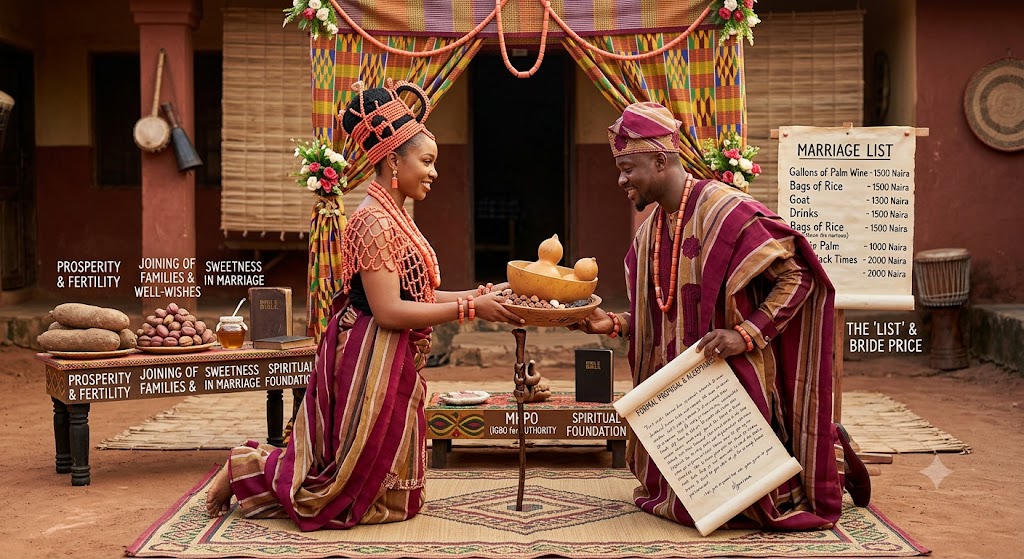
Traditional marriage is the oldest and most widely practised form of marriage in Nigeria. It is conducted according to the customs, traditions, and native laws of the ethnic communities to which the bride and groom belong. Whether among the Igbo, Yoruba, Hausa, Efik, Tiv, Ibibio, Urhobo, Ijaw, Fulani, Nupe, Kanuri, or any of Nigeria's more than 250 ethnic groups, traditional marriage remains deeply respected.
Although the ceremonies differ from one community to another, the central purpose remains the same: it is the formal union of two families, witnessed by relatives, elders, friends, and members of the community.
Traditional marriage ceremonies often involve family introductions, negotiations, presentation of gifts, payment of bride price or dowry where applicable, prayers, blessings from parents and elders, cultural dances, exchange of drinks, symbolic rites, and public acceptance of the marriage. The colourful attire, traditional music, and rich cultural displays make these ceremonies one of the highlights of Nigerian weddings.
For many Nigerians, the traditional marriage is the most emotionally significant part of the wedding because it connects the couple to their heritage and publicly demonstrates that both families have accepted the union.
What Is a Court Marriage?
Court marriage, sometimes called statutory marriage, is a marriage conducted under the Nigerian Marriage Act. It is solemnised by a licensed marriage registrar at a marriage registry or by an authorised minister in a licensed place of worship after satisfying the legal requirements prescribed by law.
Unlike customary marriage, court marriage follows uniform legal procedures throughout Nigeria regardless of tribe, culture, or religion. Once completed, the couple receives an official marriage certificate recognised throughout Nigeria and in many foreign countries.
The process generally involves giving notice of marriage, publication of the notice for any legal objections, submission of required documents, payment of statutory fees, appearance before the registrar, declaration of consent, signing of the marriage register, and issuance of the marriage certificate.
Because it is regulated by law, court marriage provides a clear legal framework governing the rights and obligations of both spouses.
The Major Differences Between Traditional Marriage and Court Marriage
Although both forms of marriage unite a man and a woman, they differ significantly in their foundation, recognition, legal consequences, and procedures.
Traditional marriage is based on customary law and the traditions of a particular ethnic community, while court marriage is governed by statutory law under the Nigerian Marriage Act. Traditional marriage derives its legitimacy from cultural acceptance and family recognition, whereas court marriage derives its authority from the Nigerian legal system.
One of the most important distinctions concerns the nature of the marriage itself. Under customary law, some traditional marriages may permit polygamy depending on the applicable custom and personal circumstances. In contrast, court marriage is strictly monogamous. A person who is legally married under the Marriage Act cannot lawfully contract another statutory marriage with someone else during the lifetime of the spouse.
The documentation involved also differs considerably. Traditional marriages may be documented by photographs, family records, customary certificates issued by local authorities, or witness testimony. Court marriages culminate in the issuance of an official government-recognised marriage certificate, which is often required for immigration applications, visa processing, insurance claims, pension benefits, international employment, banking transactions, and other legal matters.
Cultural Importance of Traditional Marriage
Traditional marriage is much more than a legal ceremony. It represents the joining of two extended families and, in many communities, two lineages. Parents, grandparents, uncles, aunts, community elders, and traditional rulers often play active roles throughout the ceremony.
Many Nigerian families regard traditional marriage as an essential rite of passage. Even highly educated couples living abroad frequently return home to celebrate their traditional wedding because of its cultural significance.
The ceremony also provides an opportunity to preserve language, traditional attire, indigenous music, dances, cuisine, and long-standing customs that have been handed down through generations.
Legal Advantages of Court Marriage
Court marriage provides several important legal protections that many couples find beneficial.
The marriage certificate serves as official proof of marriage and is widely accepted by government agencies, financial institutions, foreign embassies, employers, and courts. It simplifies many administrative processes that may otherwise require additional documentation.
Court marriage also offers legal certainty concerning inheritance rights, property ownership, next-of-kin recognition, spousal benefits, and the legal status of children born within the marriage. Where disputes arise, the statutory legal framework provides established procedures for resolving matrimonial matters.
For Nigerians planning to relocate abroad or apply for visas, a statutory marriage certificate is frequently requested as supporting evidence of the marital relationship.
Financial Considerations
One factor many couples consider is cost.
Traditional marriages vary greatly in cost depending on family expectations, local customs, and the scale of the celebration. Expenses may include bride price, traditional gifts, food, entertainment, decoration, clothing, photography, accommodation for guests, transportation, and other cultural obligations. In some communities, these costs remain relatively modest, while in others they can become substantial.
Court marriages are generally less expensive because the statutory fees are usually predictable. Couples may choose a simple registry ceremony with only a few witnesses or combine the legal ceremony with larger wedding celebrations later.
Many Nigerian couples today deliberately simplify both ceremonies to reduce financial pressure and avoid beginning married life under unnecessary debt.
Family Expectations in Nigeria
Family expectations continue to influence marriage decisions across Nigeria.
Parents often consider the traditional marriage indispensable because it formally introduces the families and fulfils cultural obligations. In many communities, parents may be reluctant to recognise a union that has not undergone customary rites.
On the other hand, couples working in multinational organisations or planning international travel often prioritise court marriage because of its legal recognition.
Rather than viewing the two forms as competing alternatives, many Nigerian families see them as complementary ceremonies that fulfil different purposes.
Can You Have Both Traditional and Court Marriage?
Yes. In fact, this is the option chosen by many Nigerian couples.
A couple may first complete the traditional marriage according to family customs and later proceed to the marriage registry for a statutory marriage. Others complete the court marriage before organising the traditional ceremony, depending on family logistics, work schedules, or immigration deadlines.
Having both ceremonies allows couples to satisfy cultural expectations while also obtaining the legal protections associated with statutory marriage.
Which Marriage Is Legally Stronger?
This question is frequently asked, but the answer depends on the context.
Traditional marriages are legally recognised under Nigerian customary law when properly conducted according to the applicable native customs. Court marriages are recognised under statutory law and are generally easier to prove because they are supported by official government documentation.
For international transactions, immigration matters, and many administrative purposes, the statutory marriage certificate issued after a court marriage is usually more readily accepted by foreign authorities.
Common Misconceptions
Many Nigerians mistakenly believe that paying the bride price alone automatically gives every legal protection associated with statutory marriage. While customary marriages are recognised under Nigerian law, they operate within the framework of customary law rather than the Marriage Act.
Another common misconception is that court marriage eliminates the need for traditional marriage. Legally, this may be sufficient for statutory purposes, but culturally many Nigerian families still expect customary rites to be performed.
Some people also assume that a lavish wedding ceremony determines the validity of a marriage. In reality, the legal validity of a marriage depends on compliance with the relevant legal or customary requirements rather than the size or cost of the celebration.
Real-Life Nigerian Scenarios
Consider a young professional couple living in Abuja whose employers transferred them to Canada shortly after their engagement. They completed a court marriage first because the statutory marriage certificate was required for immigration documentation. A few months later, after settling travel arrangements, they returned to their hometown to celebrate their traditional marriage with both families. This approach allowed them to satisfy both legal and cultural expectations.
In another example, an Igbo couple completed all customary marriage rites in their village, including payment of the bride price and blessings from both families. Years later, while processing overseas employment documents, they discovered that several institutions requested an official statutory marriage certificate. They subsequently visited the marriage registry to complete a court marriage, making future documentation much easier.
These examples illustrate that the choice is often influenced by practical needs rather than by one ceremony being inherently superior to the other.
Which Marriage Is Best for You?
There is no universal answer because every couple's circumstances differ.
If preserving cultural traditions and bringing both families together is your highest priority, traditional marriage offers tremendous emotional and cultural value. It celebrates identity, heritage, and community while reinforcing family bonds.
If your immediate priority involves legal documentation, international travel, immigration, property ownership, or statutory protections, court marriage provides important legal certainty.
For many Nigerian couples, combining both forms of marriage offers the most balanced solution. It honours family traditions while providing official legal recognition under Nigerian law.
Regardless of the path you choose, the success of your marriage ultimately depends not on the type of ceremony performed but on mutual love, respect, trust, effective communication, financial responsibility, commitment, and a shared vision for the future.
Final Thoughts
Traditional marriage and court marriage are not rivals; they serve different but equally valuable purposes within Nigerian society. Traditional marriage celebrates culture, family, ancestry, and community, while court marriage establishes a statutory legal relationship recognised by government institutions and international authorities.
As Nigeria continues to modernise while preserving its rich cultural heritage, many couples are finding ways to embrace both traditions. By understanding the differences, benefits, and legal implications of each, intending couples can make informed decisions that reflect their personal values, family expectations, and future aspirations.
Preparing for marriage involves much more than choosing the type of wedding ceremony. Couples should invest time in premarital counselling, financial planning, communication skills, conflict resolution, and understanding each other's expectations. A well-prepared marriage stands a far greater chance of lasting than one built solely on an elaborate wedding celebration.
If you are preparing for marriage or already married, MarriageHub.ng provides practical tools and resources to support your relationship journey.
Take the Marriage Readiness Test at https://www.marriagehub.ng/analyzer/index.php to assess your preparedness for marriage. If you have relationship concerns that you would like to discuss privately, ask anonymous questions at https://www.marriagehub.ng/questions-answers.
Planning your wedding or another special occasion? Create a beautiful digital invitation through https://www.marriagehub.ng/annouce-my-event/. If you are still searching for the right partner, discover compatible singles through https://www.marriagehub.ng/match-making/frontend/discover.php. You can also browse trusted wedding vendors for catering, photography, decoration, event planning, fashion, makeup, entertainment, and more at https://www.marriagehub.ng/vendors.
Become part of a thriving relationship community by joining existing Groups and Tribes at https://www.marriagehub.ng/all-groups or create your own community at https://www.marriagehub.ng/create-tribes-group.
You can also purchase relationship resources, digital downloads, wedding services, products, counselling materials, and other useful items through the MarriageHub Marketplace at https://www.marriagehub.ng/marketplace.
Follow MarriageHub Nigeria for more relationship tips, marriage advice, and wedding inspiration.
WhatsApp: https://whatsapp.com/channel/0029VbCav9MCcW4pw3GSM72w
X: https://x.com/MarriageHubNG
Facebook: https://web.facebook.com/MarriageHubNigeria
Instagram: https://www.instagram.com/marriagehubng3









.jpg)



Sign in to comment