 Nurturing Marriages, Enriching Families!
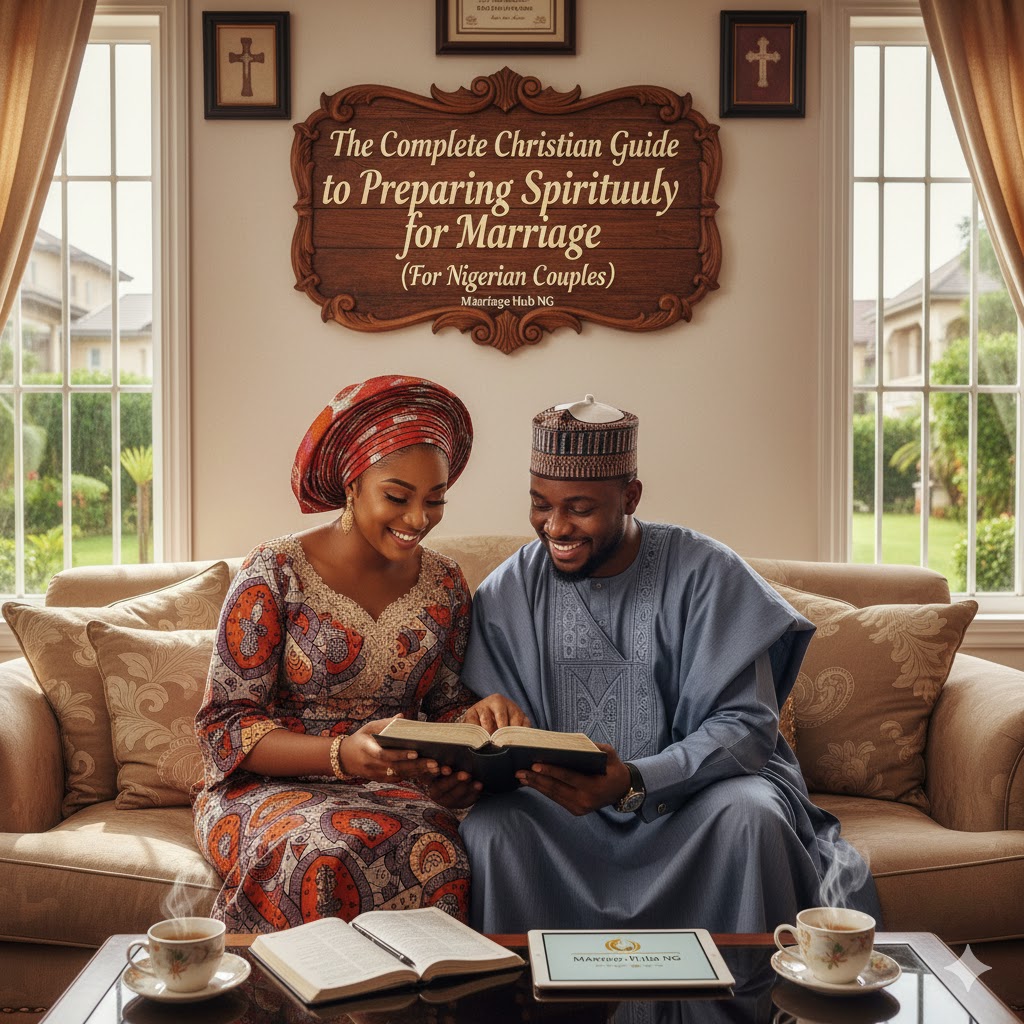
The Complete Christian Guide to Preparing Spiritually for Marriage (For Nigerian Couples)
THE COMPLETE CHRISTIAN GUIDE TO
Preparing Spiritually for Marriage
For Nigerian Couples Who Want God at the Centre of Their Union
A Comprehensive SEO Resource by MarriageHub Nigeria | marriagehub.ng
|
TABLE OF CONTENTS |
1. Introduction: Why Spiritual Preparation for Marriage Matters in Nigeria
2. The State of Christian Marriage in Nigeria — Facts & Statistics
3. What Does It Mean to Prepare Spiritually for Marriage?
4. Building a Personal Spiritual Foundation Before Marriage
5. The Role of Prayer in Preparing for Marriage
6. Understanding God's Design for Marriage — Biblical Foundations
7. Sexual Purity and Holiness in Pre-Marriage Preparation
8. Christian Pre-Marital Counselling in Nigeria — Why It Is Not Optional
9. Spiritual Compatibility — What It Means and How to Assess It
10. Dealing With Past Wounds, Soul Ties, and Spiritual Baggage
11. Praying Together as an Engaged Couple
12. Seeking Godly Community, Mentorship, and Covering
13. Fasting, Spiritual Warfare, and Your Marriage Destiny
14. The Wedding Ceremony as a Spiritual Covenant
15. Frequently Asked Questions (FAQs)
16. Related Resources on MarriageHub.ng
17. Conclusion
1. Introduction: Why Spiritual Preparation for Marriage Matters in Nigeria
Nigeria is a nation of faith. From the prayer points read over loudspeakers in early-morning Pentecostal services in Lagos, to the quiet devotions offered in Anglican churches across the old towns of Ibadan and Abeokuta, to the evangelical crusades that fill open fields in Jos, Kaduna, and Enugu — Christianity is not merely a religion in Nigeria. It is a way of life, a cultural heartbeat, a primary lens through which millions of Nigerians understand identity, purpose, family, and love.
And yet, despite this extraordinary depth of faith, Nigerian Christian marriages are breaking down at historically alarming rates. Churches overflow on Sundays, but counsellors' offices fill with hurting couples on Mondays. Couples who met in church, prayed together during courtship, and exchanged vows before God are separating within three years of marriage — not because they stopped believing, but because they entered the covenant of marriage without truly preparing for it spiritually, emotionally, and practically.
This guide exists to close that gap. It is written for every Nigerian Christian couple who wants to do more than have a church wedding — who wants to build a marriage that is genuinely rooted in God, sustained by spiritual discipline, and resilient against the pressures that Nigerian life inevitably brings. Whether you are just beginning to sense that this person may be the one, engaged and counting the days to your wedding, or already in pre-marital counselling and looking for deeper resources — this guide is written for you.
This is not a guide about what church to get married in. It is a guide about what kind of person to become before you stand at that altar. It is about the spiritual work — the prayer, the purity, the self-examination, the surrender, the community — that turns a couple who loves God into a marriage that glorifies Him.
|
Key Truth: The foundation of a godly marriage is not the wedding ceremony — it is the spiritual condition of the two people who walk into it. A ceremony lasts a few hours. A character lasts a lifetime. Prepare accordingly. |
2. The State of Christian Marriage in Nigeria — Facts & Statistics
Understanding the landscape of Christian marriage in Nigeria is not an exercise in pessimism — it is an act of wisdom. When we see clearly what is happening to marriages in our communities, we are better equipped to make choices that lead to different outcomes.
|
93% |
Of Nigerians identify as either Christian or Muslim, making Nigeria one of the most religiously active nations in the world. Despite this, the country faces a growing marriage breakdown crisis that affects Christian and Muslim households alike. (Pew Research Center, 2023) |
|
45–50% |
Estimated percentage of Nigerian Christian marriages in urban centres (Lagos, Abuja, Port Harcourt) that experience serious marital distress within the first five years, based on data from the Association of Marriage and Family Therapists of Nigeria (AMFTN, 2023). |
|
68% |
Of Nigerian Christian couples seeking counselling who had not completed any formal pre-marital preparation before their wedding, according to a survey of registered marriage counsellors in Lagos, Abuja, and Enugu (AMFTN, 2022). |
|
1 in 3 |
Nigerian Christian couples report that unaddressed spiritual and emotional baggage from before marriage was a primary contributor to early marital conflict (Covenant Marriages Research Project, Nigeria, 2021). |
|
77% |
Of Nigerian pastors and church leaders surveyed who said their congregations lacked adequate pre-marital preparation structures — beyond the standard two-to-three session 'counselling' that most churches require. (African Christian Marriage Survey, 2022) |
|
40% |
Of Nigerian Christian couples who participated in comprehensive pre-marital programmes (including spiritual formation, financial planning, and conflict resolution training) who reported significantly higher marital satisfaction at the five-year mark, compared to those who did not. (University of Lagos Department of Social Work, 2023) |
2.1 What the Data Tells Us
The picture is both sobering and hopeful. Nigerian Christians are among the most devoted believers anywhere in the world — and yet their marriages are under extraordinary pressure. The data consistently points to one preventable factor: the gap between wedding-day faith and everyday marital preparation. When that gap is closed — through intentional, comprehensive, spiritually grounded preparation — outcomes improve dramatically. This guide is designed to help you close that gap.
3. What Does It Mean to Prepare Spiritually for Marriage?
When Nigerian Christians hear 'spiritual preparation for marriage,' many immediately think of fasting and prayer for the right spouse, attending church-organised pre-marital classes, or getting the pastor's blessing before the wedding. These are valuable — but they represent only a fraction of what genuine spiritual preparation involves.
Spiritual preparation for marriage is not primarily about performing religious acts. It is about undergoing a deep, lasting transformation of your character, your intimacy with God, your understanding of covenant, and your capacity to love another person sacrificially over a lifetime. It is about becoming ready — not just excited.
3.1 The Four Dimensions of Spiritual Marriage Preparation
Dimension 1: Personal Spiritual Depth
Before you can share a spiritual life with a spouse, you must have one of your own. Your prayer life, your knowledge of Scripture, your obedience to God in daily decisions, your sensitivity to the Holy Spirit — these are not things that automatically improve after the wedding. If anything, the pressures of marriage tend to expose and amplify the spiritual condition you brought into it. The first priority of spiritual preparation is deepening your own walk with God — not just praying about who to marry, but becoming the kind of person who is ready for the commitment of marriage.
Dimension 2: Spiritual Healing and Wholeness
Most adults carry wounds from their past — childhood experiences of abandonment, betrayal, emotional abuse, sexual sin, broken families, disappointment with God, or unresolved grief. These wounds do not disappear when you say 'I do.' In fact, the vulnerability and intimacy of marriage tends to open them wide. Spiritual preparation includes bringing your wounds, your sin patterns, and your unhealed areas honestly before God — and before a trusted counsellor or mentor — for healing and freedom before you enter the covenant.
Dimension 3: Theological Understanding of Marriage
A shockingly large percentage of Nigerian Christian couples enter marriage with a primarily cultural understanding of it — what their parents modelled, what their ethnic group practises, what society expects — rather than a robustly biblical one. Understanding what God actually says about the covenant of marriage, the roles of husband and wife, the purpose of sex, the nature of covenant commitment, and the spiritual warfare that attacks marriages gives couples a framework for building something intentional rather than simply repeating inherited patterns.
Dimension 4: Relational and Spiritual Alignment
Spiritual compatibility — having a shared theological foundation, aligned values, similar spiritual practices, and genuine mutual respect for each other's relationship with God — is one of the strongest predictors of long-term marital success in Christian research. Assessing and building this alignment before marriage is essential spiritual preparation work, and is explored in depth in Section 9 of this guide.
|
Biblical Foundation: 'For this reason a man will leave his father and mother and be united to his wife, and the two will become one flesh. So they are no longer two, but one flesh. Therefore what God has joined together, let no one separate.' (Matthew 19:5–6). The covenant of marriage is God's design. Preparing for it as such is an act of worship. |
4. Building a Personal Spiritual Foundation Before Marriage
The most important spiritual preparation for marriage is not anything you do as a couple — it is what you do as an individual before the couple relationship begins. The person you are when you walk into marriage is the person who will show up in every argument, every crisis, every moment of vulnerability, and every ordinary Tuesday evening. Who that person is spiritually matters enormously.
4.1 Cultivating a Consistent Prayer Life
Prayer is the primary language of your relationship with God. A person preparing for marriage who rarely prays is attempting to build a house without a foundation. Consistency matters more than intensity. A daily 20-minute personal prayer time — covering thanksgiving, confession, Scripture meditation, intercession for your future spouse and marriage, and quiet listening — builds the spiritual musculature that marriage will demand.
Specific prayer areas for singles preparing for marriage include: clarity of God's call and direction regarding the relationship; personal holiness and the grace to pursue purity; healing of past wounds and freedom from unhealthy relationship patterns; wisdom in discernment and assessment of character; and protection over both individuals as the relationship develops.
4.2 Deep Engagement With Scripture
The Bible is the foundational text for Christian marriage. Couples who enter marriage with deep, personal knowledge of what Scripture says about covenant, love, forgiveness, sacrifice, submission, leadership, sex, money, family, and conflict are immeasurably better equipped than those whose familiarity with Scripture is superficial or secondhand. Regular, disciplined Bible study — not just devotional reading, but careful study of relevant passages — is one of the most practical spiritual preparation tools available.
Key Scripture passages for pre-marriage study include: Genesis 1–2 (God's original design for marriage), Ephesians 5:22–33 (the biblical theology of marriage as a reflection of Christ and the Church), 1 Corinthians 13 (the nature of genuine love), Proverbs 31 and 1 Peter 3 (character in marriage), Song of Solomon (intimacy and delight), and Malachi 2:13–16 (the seriousness of the marriage covenant in God's sight).
4.3 Active Church Membership and Accountability
Nigerian Christians are generally church-attending. But active church membership — involving genuine community, transparent accountability relationships, spiritual covering from a pastor or elder who knows you personally, and consistent serving — is qualitatively different from weekly attendance. Research consistently shows that couples who are deeply embedded in healthy church community before and during marriage experience significantly better marital outcomes than those who are nominally connected.
If your church does not offer a genuine community of accountability and care — a small group, a discipleship structure, a pastoral relationship — seek one. You need a community that knows you, not just a crowd that sees you on Sundays.
4.4 Financial Stewardship as Spiritual Discipline
Money is one of the leading causes of marital conflict among Nigerian Christian couples. Financial preparation is therefore spiritual preparation. Building the disciplines of tithing, generous giving, responsible saving, and wise budgeting before marriage — and doing so as an act of obedience to God rather than merely as practical wisdom — develops a character and a spiritual posture that protects your future marriage from one of its most common threats.
|
"Bring all the tithes into the storehouse... and see if I will not throw open the floodgates of heaven and pour out so much blessing that there will not be room enough to store it." — Malachi 3:10 |
5. The Role of Prayer in Preparing for Marriage
No dimension of spiritual preparation for marriage is more consistently emphasised in Nigerian Christian culture — and none is more frequently misunderstood or misapplied. Prayer in the context of marriage preparation is not primarily a mechanism for getting God to give you the spouse you want. It is a relational practice that forms your character, aligns your will with God's, builds discernment, and positions you to both give and receive love well.
5.1 What to Pray When Preparing for Marriage
Pray for Self-Knowledge
Ask God to show you who you truly are — your strengths, your blind spots, your wounds, your sin patterns, your insecurities, and your relational habits. Self-knowledge is one of the most undervalued assets in marriage preparation. The person who genuinely knows themselves is far better equipped to communicate honestly, set healthy boundaries, and grow through conflict than the person who has never stopped to reflect on their own character.
Pray for Discernment
Nigerian Christian culture is rich with teachings on 'confirming your spouse.' While some of this tradition is deeply valuable, discernment in marriage is not primarily about dreams, prophecies, or fleece-laying — it is about patiently and prayerfully observing character over time. Pray for the wisdom to see clearly, to evaluate both the visible and the hidden dimensions of a person's character, and to discern between attraction and genuine compatibility.
Pray for Your Future Spouse
Whether or not you have identified a specific person, praying intentionally for your future spouse — their spiritual growth, their protection from harm, their healing from past wounds, their professional development, their family relationships — is a profoundly formative practice. It cultivates generosity of spirit, care for another person's flourishing, and a posture of service that is foundational to healthy marriage.
Pray for God's Will, Not Yours
The single most important prayer a Nigerian Christian can pray regarding marriage is the prayer of surrender: 'Lord, not my desire for this particular person, but Your perfect will for my life.' Marriages entered through manipulation of circumstances, emotional pressure, or the desperate fear of remaining single — rather than through genuine peace and God's clear direction — carry a spiritual deficit from the very beginning. Pray for the courage and the trust to wait for God's best.
5.2 Prayer Practices for Engaged Couples
Once a couple is formally engaged, their shared prayer life becomes a crucial part of their preparation. The quality of a couple's prayer together before marriage is one of the strongest indicators of the spiritual health of their marriage. Prayer together should cover:
• Thanking God for each other and for the gift of the relationship
• Inviting God's guidance into major decisions — venue, finances, family dynamics, timelines
• Confessing and seeking forgiveness for sins committed individually and against each other
• Interceding for both families and the extended family dynamics the marriage will navigate
• Praying over each other's weaknesses, wounds, and areas of spiritual growth
• Declaring God's purposes and promises over their future home, family, and ministry
6. Understanding God's Design for Marriage — Biblical Foundations
One of the most urgent needs in Nigerian Christian pre-marital preparation is a robustly biblical theology of marriage. Too many Nigerian Christians approach marriage primarily through the lens of culture — ethnic traditions, family expectations, Nollywood narratives, or the examples (good and bad) of parents and elders — rather than through the lens of what God's word actually reveals about the nature, purpose, and structure of the marriage covenant.
6.1 Marriage as Covenant, Not Contract
Nigerian law recognises marriage as a legal contract — an agreement between two parties that can be entered and dissolved under defined conditions. But the Bible presents marriage as a covenant — a binding, sacred commitment before God that is not contingent on the other person's performance, not dissoluble by mutual preference, and not merely about what each party receives from the arrangement. Understanding this distinction changes everything about how a couple approaches preparation, commitment, and the hard seasons of married life.
A contract says: 'I will fulfil my obligations as long as you fulfil yours.' A covenant says: 'I commit to you unconditionally, before God, regardless of what this costs me.' Nigerian Christians preparing for marriage must genuinely reckon with which of these they are actually prepared to enter.
6.2 The Purpose of Marriage in Scripture
Scripture presents marriage as serving several simultaneous purposes, all of which should shape how couples prepare:
• Companionship and mutual completion: 'It is not good for the man to be alone. I will make a helper suitable for him.' (Genesis 2:18) — Marriage addresses human loneliness in its deepest form.
• Reflecting God's nature: Created in God's image as 'male and female' (Genesis 1:27), the union of husband and wife reflects the relational, self-giving nature of the Trinity in a way no other human relationship does.
• A picture of the Gospel: Ephesians 5 presents the marriage of husband and wife as a living metaphor of Christ's sacrificial, covenant love for the Church. This is the most profound biblical reason for taking the spiritual preparation of marriage seriously.
• Fruitfulness and building legacy: 'Be fruitful and multiply' (Genesis 1:28) — the family is God's primary vehicle for generational faithfulness, cultural transformation, and Kingdom expansion.
• Sanctification: Marriage is one of God's primary tools for forming godly character. The friction, vulnerability, and sacrifice of married life regularly exposes selfishness, pride, and fear in ways that singleness cannot — and transforms them into love, humility, and courage.
6.3 Biblical Roles in Marriage — A Nigerian Conversation
Few topics generate more heat in Nigerian Christian pre-marital conversations than the question of gender roles in marriage. The cultural overlay — with its traditions of male authority, female deference, and extended family governance — can make it genuinely difficult for Nigerian couples to engage honestly and carefully with what Ephesians 5 actually teaches, without filtering it entirely through inherited patriarchal cultural assumptions.
A careful reading of Ephesians 5:22–33 reveals a radical mutuality embedded in a hierarchical structure. The husband is called to a love so sacrificial, so Christlike, and so costly — 'as Christ loved the church and gave himself up for her' — that it is not authority in any self-serving sense. The wife's submission is called in the context of mutual submission (verse 21), not unilateral subjugation. Nigerian couples must do the hard work of reading this passage carefully, together, in its full context — and then discussing honestly and specifically what it means for their particular marriage.
|
"Submit to one another out of reverence for Christ. Wives, submit yourselves to your own husbands as you do to the Lord... Husbands, love your wives, just as Christ loved the church and gave himself up for her." — Ephesians 5:21–22, 25 |
7. Sexual Purity and Holiness in Pre-Marriage Preparation
Sexual purity is one of the most discussed, most misunderstood, and most practically neglected aspects of spiritual marriage preparation among Nigerian Christians. The culture of Nigerian Christianity often creates a sharp public/private gap on this issue — where sexual sin is heavily condemned from the pulpit but rarely addressed with genuine compassion, practical guidance, or real accountability in the pastoral or counselling setting. This gap leaves many Nigerian Christian couples spiritually and emotionally unprepared to navigate their sexual lives — both before and after marriage.
7.1 The Spiritual Case for Pre-Marriage Sexual Purity
Sexual purity before marriage is not merely a rule to follow — it is a profoundly practical gift to your future spouse and your future marriage. Sexual activity outside of the marriage covenant creates emotional and spiritual bonds — what many refer to as 'soul ties' — that complicate the exclusive, covenant intimacy that God intends for marriage. Couples who have been sexually active before marriage consistently report that previous sexual relationships create comparison, distrust, shame, and emotional complications in their marital intimacy. Purity protects against these complications.
It is important to note that sexual purity is not only about avoiding intercourse. It includes the management of sexual thought life, the boundaries around physical affection during courtship, the consumption of pornography, and the emotional enmeshment that can develop through emotionally intimate but non-committal relationships. Nigerian Christian couples must address all of these areas honestly as part of their spiritual preparation.
7.2 What to Do If You Have Already Crossed Sexual Boundaries
One of the most important and most underemphasised truths in Nigerian Christian marriage preparation is this: God's grace is sufficient for every sexual sin. For the many Nigerian Christian couples who have been sexually active before or during courtship — whether with each other or with previous partners — the path forward is not denial, shame-driven silence, or the pretence that it did not happen. It is genuine repentance, transparent confession (appropriately given), counselling support, and the full appropriation of God's forgiveness and restoration.
A couple that has sinned sexually and genuinely repented — confessing to God, repenting together before a pastor or counsellor, establishing new boundaries, and receiving God's forgiveness — is in a spiritually healthier position than a couple that has not sinned sexually but has never discussed sex, desire, or boundaries honestly. Repentance and grace are more powerful foundations for a marriage than a false purity maintained through avoidance rather than genuine sanctification.
|
Pastoral Guidance: If you and your partner have been sexually active, bring this before God together, seek pastoral counsel, and receive God's forgiveness fully and consciously. Do not carry shame into your marriage covenant. Confessed and forgiven sin loses its power over your marriage. Concealed sin does not. |
8. Christian Pre-Marital Counselling in Nigeria — Why It Is Not Optional
The standard practice in most Nigerian churches is to require two to four pre-marital counselling sessions with the pastor or a church elder before a couple can be married in the church. This is a valuable foundation — but it is rarely sufficient. Two sessions cannot adequately address the full complexity of two people's histories, personalities, communication styles, financial habits, family dynamics, and theological understandings as they prepare for a lifetime together.
8.1 What Comprehensive Pre-Marital Counselling Covers
Comprehensive Christian pre-marital counselling — which typically spans six to twelve sessions with a trained counsellor — addresses:
• Family of origin and how each partner's upbringing shapes their expectations, communication style, and emotional responses
• Communication skills — active listening, expressing needs clearly, resolving conflict constructively
• Conflict resolution — understanding each person's conflict style and developing healthy patterns
• Financial compatibility — income, spending habits, debt, financial goals, and biblical stewardship
• Sexual expectations — open, frank discussion of intimacy, desire, and sexual history (with appropriate boundaries)
• Spiritual compatibility — theological alignment, prayer practices, church involvement, and discipleship
• Extended family management — in-law boundaries, family obligations, cultural expectations
• Parenting values and plans — number of children, discipline philosophy, education decisions
• Career and life goals — how individual ambitions will be integrated with the marriage partnership
8.2 Finding a Qualified Christian Marriage Counsellor in Nigeria
Not all pre-marital counselling in Nigeria is equally effective. A genuinely qualified Christian marriage counsellor combines professional training (in counselling psychology or related fields), personal Christian faith, marital experience, and specific expertise in pre-marital and marital dynamics. When evaluating a counsellor, Nigerian couples should ask: What is your professional training? Do you have experience with pre-marital counselling specifically? What is your theological framework? Are you able to discuss our specific cultural and ethnic context with competence?
MarriageHub Nigeria connects couples with qualified Christian marriage counsellors at marriagehub.ng/find-therapist. Do not rely only on your wedding pastor's availability — invest in counselling that is thorough, professional, and specifically oriented toward your preparation, not just your ceremony.
9. Spiritual Compatibility — What It Means and How to Assess It
'Do not be unequally yoked with unbelievers' (2 Corinthians 6:14) is one of the most quoted and most frequently misapplied scriptures in Nigerian Christian marriage conversations. The verse is almost universally interpreted as prohibiting marriage between Christians and non-Christians — which is indeed its primary meaning. But Nigerian Christian couples often use this passage to avoid a harder, more personal question: are we spiritually compatible with each other, as two Christians?
9.1 Beyond Shared Denominational Label
The fact that two people are both Christians — or both Pentecostal, or both Anglican, or both Baptist — does not automatically make them spiritually compatible for marriage. Spiritual compatibility involves a much richer set of considerations:
• Do you share a similar understanding of who God is and how He works?
• Are your prayer practices compatible — do you pray in ways that complement rather than alienate each other?
• Are your expectations about church involvement, denominational loyalty, and spiritual authority aligned?
• Do you share similar theological convictions about the core matters that will shape your family — childrearing, financial giving, spiritual warfare, the role of prophecy and gifts, the place of ancestral customs?
• Do you genuinely respect each other's spiritual instincts, or does one partner consistently dismiss or condescend toward the other's spiritual experience?
• Are you able to pray together with vulnerability, honesty, and genuine intimacy?
9.2 Red Flags in Spiritual Compatibility
The following patterns, observed before marriage, are significant spiritual compatibility concerns that should be addressed in counselling rather than ignored or explained away:
• One partner rarely or never prays privately, despite claiming Christian faith
• Significant disagreement about the authority of Scripture in daily decision-making
• One partner is deeply involved in spiritual practices — fasting, intercession, prophetic community — that the other finds alienating or excessive
• Unresolved theological differences about the nature of salvation, the work of the Holy Spirit, or the authority of apostolic/pastoral figures
• Discomfort with the other's family's spiritual practices, ancestral beliefs, or cultural-religious rituals that are presented as non-negotiable
• A pattern of one partner consistently deferring spiritually to the other rather than having a genuinely independent walk with God
|
Caution: Spiritual compatibility cannot be manufactured by matching denominational labels or agreeing to attend the same church. It is built through honest, extended observation of each other's actual spiritual life — in prayer, in crisis, in moral decision-making, and in ordinary daily life. Give yourselves enough time before the wedding to truly know each other spiritually. |
10. Dealing With Past Wounds, Soul Ties, and Spiritual Baggage
Every person who stands at the altar carries a history. For many Nigerian Christians, that history includes sexual relationships that created spiritual and emotional bonds, experiences of childhood trauma or abandonment, patterns of unhealthy relating learned from dysfunctional family environments, deep disappointments with God during periods of suffering, and spiritual wounds inflicted by church leadership failures or religious abuse. These are not merely psychological matters — they are spiritual matters, and they follow people into marriage if they are not consciously and prayerfully addressed.
10.1 Understanding Soul Ties
The concept of 'soul ties' — the spiritual bonds formed through intimate relationships, particularly sexual ones — is deeply embedded in Nigerian Pentecostal and charismatic Christian teaching, and the underlying spiritual reality it describes has genuine biblical grounding. 'The two shall become one flesh' (Genesis 2:24) is not merely a metaphor. Sexual intimacy creates genuine spiritual union, which is why Paul can say in 1 Corinthians 6:16 that even a man who joins himself to a prostitute 'becomes one with her in body.' Sexual relationships outside of marriage create spiritual bonds that are not automatically dissolved when the relationship ends.
For Nigerian Christian couples preparing for marriage, honestly examining and prayerfully renouncing ungodly soul ties from previous relationships — through genuine repentance, pastoral prayer, and the deliberate appropriation of the blood of Christ for cleansing and freedom — is not spiritual excess. It is wise, practical preparation.
10.2 Healing From Family of Origin Wounds
The family we grew up in programmes our deepest expectations, our default emotional responses, and our instinctive patterns of relating — for good and for ill. A Nigerian man who grew up watching his father treat his mother with contempt carries an internal template for how husbands treat wives that will unconsciously shape his behaviour unless it is consciously examined, grieved, and replaced. A Nigerian woman who experienced abandonment or emotional unavailability from her father brings that wound into her relationship with her husband, often experiencing his normal human limitations as catastrophic rejection.
Spiritual healing from family of origin wounds involves: honest acknowledgment of the wounds (which Nigerian culture's emphasis on family honour and resilience often discourages); grieving the losses appropriately rather than burying them; forgiveness of those who caused harm — not as emotional approval of what they did, but as spiritual release of the debt; and the deliberate replacement of false beliefs ('all men are unfaithful,' 'my needs are not important,' 'I must earn love') with the truth of Scripture.
10.3 Breaking Generational Patterns
Nigerian families often carry recurring patterns across generations — cycles of infidelity, financial mismanagement, domestic violence, emotional unavailability, marital breakdown, or spiritual compromise. These patterns are not inevitable destiny — they are habits, traumas, and spiritual inheritances that can be broken through prayer, counselling, deliberate choice-making, and the power of the Holy Spirit. Couples who consciously identify the generational patterns they do not want to reproduce, and who take active spiritual and practical steps to break them, are far more likely to build something genuinely new.
11. Praying Together as an Engaged Couple
One of the most revealing tests of spiritual compatibility and one of the most powerful tools of marriage preparation available to Nigerian Christian couples is the discipline of praying together during the engagement period. Prayer together, done honestly and consistently, creates a level of spiritual intimacy and vulnerability that no other activity can replicate — and it builds the pattern of joint spiritual leadership that a Christian marriage requires.
11.1 Why Praying Together Feels Difficult
Many Nigerian Christian couples who pray privately and attend church faithfully find praying together as a couple surprisingly difficult. This is normal and instructive. Praying together requires a kind of vulnerability — authenticity about your inner spiritual life, your fears, your failures, your deepest longings — that many Nigerians, particularly men who have been socialised to project strength and avoid emotional exposure, find genuinely uncomfortable.
That discomfort is itself valuable information. If you cannot be vulnerable in prayer with the person you intend to marry for life, that is a conversation worth having before the wedding — not after. A man who has never prayed with his fiancée, who leads corporate church worship but cannot bring himself to pray honestly with the woman he loves, needs to examine why — and so does she.
11.2 A Practical Guide to Praying Together as an Engaged Nigerian Couple
1. Begin with thanksgiving — specifically naming things you are grateful for about each other. This practice shifts the emotional tone of prayer from transactional to relational.
2. Read and reflect on a short Scripture passage together before praying. This gives prayer a shared foundation and reduces the pressure of finding 'the right words.'
3. Pray honestly — not performatively. God is not impressed by eloquent prayers that conceal real concerns. Honesty in prayer with your partner builds trust far faster than spiritual performances.
4. Pray specifically for each other's needs, struggles, and growth areas. This requires knowing each other deeply enough to pray specifically — which itself is a preparation discipline.
5. Include prayer for your future home, family, finances, and ministry. Praying over the vision for your marriage gives that vision spiritual weight and divine covering.
6. Pray together in whatever spiritual language is authentic to you — whether in formal liturgical prayer, extemporaneous charismatic prayer, or a combination. Mutual respect for each other's prayer style is part of spiritual compatibility.
12. Seeking Godly Community, Mentorship, and Covering
Marriage preparation in Nigerian Christianity is too often treated as a private, couple-centred exercise. But God's design for the formation of healthy marriages is communal. We were never meant to discern, prepare, and enter the covenant of marriage alone — we were designed to do it in the context of a community that knows us, loves us, challenges us, and holds us accountable. The search for godly community, mentorship, and spiritual covering is not a nice-to-have for marriage preparation in Nigeria — it is a non-negotiable.
12.1 The Value of Marriage Mentors
A marriage mentor is a couple who are further down the journey than you — who have built a marriage you respect, who have navigated challenges you can learn from, and who are willing to invest in your preparation with honesty, wisdom, and prayer. The impact of a genuinely good marriage mentor on a Nigerian Christian couple preparing for marriage cannot be overstated.
The best marriage mentors are not necessarily the most publicly successful or the most theologically educated couples in your church — they are the couples who are honest about their journey, who demonstrate genuine love and respect for each other in the ordinary moments of life, and who are willing to be vulnerable about what they have learned through hardship as well as blessing.
If your church does not have a formal mentoring programme, identify a couple you respect — your pastor and his wife, an elder couple, a small group leader — and ask them directly for mentorship. Most couples are honoured to be asked.
12.2 Pastoral and Spiritual Covering
The concept of spiritual covering — the accountability, authority, and protection that comes from being genuinely submitted to trustworthy spiritual leadership — is deeply valued in Nigerian Christian culture. For marriage preparation, this means more than having your pastor sign the wedding form. It means being genuinely known by a pastor or spiritual elder who has enough relational access to speak honestly into your lives, to pray authoritatively over your relationship, and to provide real accountability.
If your current church relationship is primarily anonymous — you attend, you give, but no one in spiritual leadership truly knows you — that is a deficit worth addressing before your wedding day. Marriages entered under genuine spiritual covering are protected in ways that isolated marriages are not.
13. Fasting, Spiritual Warfare, and Your Marriage Destiny
The spiritual warfare around marriage is one of the most consistently emphasised topics in Nigerian Pentecostal Christianity — and for good reason. Marriage is under attack. The statistics confirm it, the testimony of countless couples confirms it, and Scripture confirms it: the enemy of our souls has a particular hostility toward God-honouring marriage, because marriage — as a covenant that reflects the relationship between Christ and the Church — is a powerful expression of divine truth in the material world.
13.1 The Role of Fasting in Marriage Preparation
Fasting — the voluntary abstention from food (and sometimes other pleasures) for the purpose of concentrated spiritual focus and prayer — is one of the most powerful spiritual disciplines available to Nigerian Christians preparing for marriage. Fasting does not change God's mind — God's mind toward you is already settled in love. What fasting changes is you. It breaks the dominance of appetite and comfort over the spirit, sharpens spiritual sensitivity, and creates a posture of absolute dependence on God that produces the clarity and boldness needed for major life decisions.
For couples preparing for marriage, specific occasions for fasting include: periods of serious discernment (Is this the right person?); before major conversations or decisions (finances, family expectations, timeline); when persistent obstacles or conflicts arise in the relationship; and in the weeks before the wedding itself, to enter the covenant with a spirit of prayer and surrender rather than merely celebration and anticipation.
13.2 Standing in Spiritual Authority Over Your Marriage
Nigerian Christian tradition carries a rich inheritance of declarative, authoritative prayer — standing on the promises of Scripture, binding the works of darkness, and declaring God's purposes over specific situations. This tradition, applied with theological balance and genuine faith, is a powerful resource for marriage preparation.
Couples preparing for marriage can stand in spiritual authority over the following: the purity and protection of their covenant relationship during the engagement period; the healing of family of origin wounds that could undermine the marriage; the alignment of both families in support of the union; the financial blessing and provision needed to build a home; and the clarity of God's purposes and vision for the marriage and family they are building.
|
"For our struggle is not against flesh and blood, but against the rulers, against the authorities, against the powers of this dark world and against the spiritual forces of evil in the heavenly realms." — Ephesians 6:12 |
14. The Wedding Ceremony as a Spiritual Covenant
In Nigerian Christian culture, the wedding ceremony is often experienced primarily as a social event with a religious component — a day of celebration, family gathering, fashion, feasting, and public display — at the centre of which there is a church service. This is not inherently wrong; the celebration of a new family is a genuinely beautiful and culturally significant thing. But when the social dimensions of the wedding consistently overshadow its spiritual significance, something essential is lost.
14.1 Understanding What You Are Entering
The Christian wedding ceremony is a covenant-making event. At its centre is not a fashion show, a reception, or a family reunion — it is a moment in which two people make an unconditional, lifetime commitment before God and witnesses, in a form that Scripture treats as a sacred and irrevocable bond. Understanding this with genuine depth, rather than merely assenting to it intellectually, changes how a couple approaches the ceremony itself and everything that comes after.
Nigerian couples preparing for Christian marriage should spend dedicated time — in prayer, in Scripture study, and in counselling — genuinely reckoning with the weight of the vows they will make. 'To have and to hold, from this day forward, for better for worse, for richer for poorer, in sickness and in health, to love and to cherish, until death do us part' is not a poetic phrase to be recited before the dancing begins. It is a covenant declaration that invites God Himself as witness and guarantor of what is being promised.
14.2 Making Your Wedding Ceremony Spiritually Intentional
The ceremony design itself can be an act of spiritual worship. Nigerian Christian couples who approach their wedding ceremony with intentionality — choosing readings that reflect genuine conviction, writing vows that capture their real understanding of covenant, inviting prayer that is spiritually authoritative and personally meaningful, and including moments of consecration and dedication — create a ceremony that functions as genuine spiritual formation, not merely tradition performance.
The most meaningful Nigerian Christian wedding ceremonies are those in which it is evident to every witness present that two people who love God are making a conscious, joyful, costly, and sacred commitment to each other and to Him. That kind of ceremony is worth every preparation effort, worth every difficult conversation, and worth every sacrifice made in the months and years before the day arrives.
15. Frequently Asked Questions (FAQs)
Q1: How long should spiritual preparation for marriage take?
There is no fixed timeline, but genuine spiritual preparation for marriage is not a process that can be compressed into a few months of engagement. The most foundational preparation — building personal spiritual depth, pursuing healing, establishing accountability, and developing character — is a lifelong process that should be underway long before any specific relationship. Within the context of a relationship moving toward marriage, a minimum of 12–18 months of engaged courtship, including at least six sessions of comprehensive pre-marital counselling, is what most experienced Nigerian marriage counsellors recommend. Rushing into the wedding ceremony before this preparation is complete is one of the most common and most costly mistakes Nigerian Christian couples make.
Q2: My partner is a Christian but is not as spiritually committed as I am. Should I marry them anyway?
This is one of the most important questions a Nigerian Christian can ask, and one of the most difficult to answer honestly. Different levels of spiritual maturity do not automatically disqualify a relationship — all couples exist somewhere on a spectrum, and growth is possible. What matters is the direction of travel: Is your partner genuinely growing in their faith, even if they are currently less mature than you? Are they open to counselling, to accountability, and to being challenged? Do they respect your spiritual life and support your relationship with God, even where theirs differs? If the answer is yes, the relationship may be workable with honest conversation and clear expectations. If your partner is consistently dismissive of your faith, resistant to spiritual growth, or unable to support your relationship with God, that is a fundamental incompatibility that no wedding ceremony will resolve.
Q3: Is it possible to be spiritually prepared for marriage if you have had multiple sexual partners in the past?
Yes — absolutely and emphatically yes. The grace of God is not rationed according to sexual history. The process of genuine repentance, honest confession, counselling support, and the deliberate receiving of God's forgiveness and restoration is available to every person, regardless of their past. What is required is honesty — with God, with yourself, and appropriately with your future spouse — and genuine, sustained repentance. Marriages built on the foundation of genuine grace and honest restoration are often among the most spiritually rich and deeply loving, because the people in them have learned in the most personal way possible that God's love is not contingent on performance.
Q4: How do we handle significant theological differences in our relationship?
Not all theological differences are equal. Differences on secondary matters — worship style preferences, specific charismatic practices, minor doctrinal distinctions within orthodox Christianity — are workable through honest conversation, mutual respect, and a willingness to honour each other's spiritual experience. Differences on core matters — the nature of salvation, the authority of Scripture, the Lordship of Christ, the reality and ethics of Christian living — are more serious and require careful, frank discussion in pre-marital counselling before proceeding. The key question is not whether you agree on everything, but whether you can build a shared spiritual life that honours both your individual relationships with God and your joint covenant before Him.
Q5: My family is pressuring me to marry quickly. How do I honour my family while insisting on proper spiritual preparation?
Family pressure around marriage timelines is one of the most common sources of spiritually impoverished marriage preparation in Nigeria. The response must be both respectful and firm. You honour your family by communicating your intentions honestly, by showing them the seriousness and intentionality of your preparation, and by including them appropriately in the process. You honour God — and your future marriage — by refusing to allow social pressure to substitute for genuine preparation. A respectful but clear conversation that says 'We intend to marry by [date], and we are committed to completing our preparation properly in order for the marriage to be strong' is both honouring and honest. Most families, when they understand that the preparation serves the marriage rather than delaying it, are supportive.
Q6: Can we do pre-marital counselling online?
Yes — particularly since COVID-19, online pre-marital counselling has become well-established and has been shown to be effective, including for Nigerian couples in diaspora or those in cities without easy access to qualified Christian counsellors. What matters is not the medium but the quality and comprehensiveness of the counselling itself, and the genuine commitment of both partners to engage honestly. MarriageHub Nigeria can connect you with qualified counsellors available for online sessions at marriagehub.ng/find-therapist.
Q7: Is it spiritually acceptable to marry someone of a different Christian denomination?
Inter-denominational Christian marriage — between, say, a Pentecostal and an Anglican, or a Baptist and a Catholic — is theologically permissible and practically workable, provided both partners share the fundamental convictions of orthodox Christianity, genuinely respect each other's spiritual backgrounds, and have developed a clear, honest plan for how they will worship together, raise their children, and manage denominational loyalties as a family. The challenges are real — significant differences in worship culture, theological emphasis, and community expectations can create friction. But with thorough pre-marital counselling and genuine mutual respect, inter-denominational marriages in Nigeria can be deeply enriching.
16. Related Resources on MarriageHub.ng
Deepen your spiritual and relational preparation with these companion articles from MarriageHub Nigeria — each one expanding on a key theme covered in this guide:
1. Preparing for a God-Centered Marriage: Lessons for Engaged Christian Couples (Nigerian Guide)
2. How a Pre-Wedding Devotional Can Strengthen Your Relationship Before Marriage (Nigerian Guide)
3. 7 Biblical Principles Every Christian Couple Should Understand Before Saying “I Do” (Nigerian Guide)
4. Praying Together Before Marriage: How Couples Can Build a Strong Spiritual Foundation
5. Why Spiritual Preparation Is Important Before Marriage for Christian Couples
6. How Faith Saved Our Marriage: Real Testimonies
7. How Spiritual Growth Can Improve Your Marriage
8. Faith-Centered Approaches to Marriage Challenges: Strengthening Your Union in Nigeria
9. Dealing with In-Law Conflicts in a Godly Way: Biblical Wisdom for Peaceful Family Relationships
10. From Courtship to Commitment: A Faith Journey Worth Taking
11. Celebrating Milestones With Faith and Joy
17. Conclusion: The Marriage God Has Prepared for You Is Worth Preparing For
Nigeria is a nation of extraordinary faith — and the God who is worshipped in its thousands of churches, its countless home cell groups, its campus fellowships, and its early-morning prayer meetings is entirely capable of building marriages in this country that are beautiful, enduring, and genuinely glorifying to Him. The problem is not God's capacity. The problem is the gap between the faith Nigerians profess on Sunday and the preparation they do before the altar.
Spiritual preparation for marriage is not about performing a checklist of religious activities so that God will bless your union. It is about becoming the person — healed, formed, grounded, surrendered — who is genuinely ready to love another imperfect person with covenant faithfulness over a lifetime. It is about entering the most significant human relationship you will ever have with your eyes open, your heart surrendered, and your foundation firmly in the One who invented marriage in the first place.
The couples whose marriages stand the test of time in Nigeria — through economic pressure, extended family conflict, career disappointments, health crises, parenting challenges, and the slow attrition of years — are not the couples who had the most spectacular weddings or the most romantic courtships. They are the couples who built their house on the rock: on Christ, on His Word, on genuine community, on daily prayer, on transparent accountability, and on the daily choice to love not because they feel like it but because they made a covenant before God and they intend to keep it.
|
"Unless the Lord builds the house, the builders labour in vain." — Psalm 127:1 |
Let the Lord build your house. Prepare with everything you have. And trust Him with everything you cannot control. The marriage He has prepared for you — and the person He is preparing you to be — is worth every prayer, every counselling session, every difficult conversation, every act of surrender, and every day of patient, intentional, God-centred preparation.
|
Your marriage will be one of the most significant acts of worship you will ever offer. Prepare it accordingly. Begin today. |
|
JOIN THE MARRIAGEHUB NIGERIA COMMUNITY |
You do not have to prepare for marriage alone. MarriageHub Nigeria is a community of thousands of Nigerian Christians — engaged couples, newlyweds, and seasoned married believers — committed to building God-honouring marriages in the Nigerian context.
Join groups & tribes of Christian couples: marriagehub.ng/all-groups
Create your own faith & marriage group: marriagehub.ng/create-tribes-group
Browse Christian marriage resources & downloadables: marriagehub.ng/marketplace
Follow MarriageHub Nigeria
Daily inspiration, expert guidance, and community for Nigerian Christian couples:
|
|
|
X / Twitter |
|
|
|
|
✝ May your marriage be a radiant testimony of God's covenant love. ✝





.jpg)
Sign in to comment